PAGE: 10
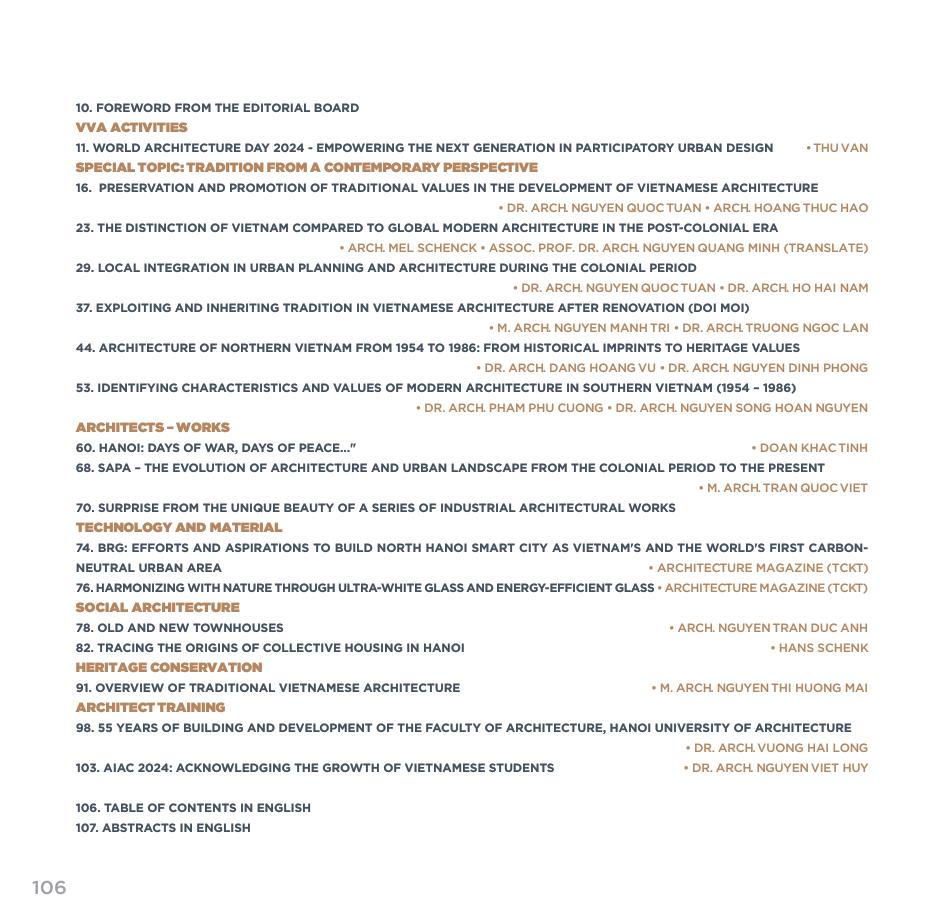
Foreword from the editorial board:
Dear readers,
Incorporating traditional values into contemporary architecture is an inevitable trend in the design thinking process, expressed differently by each individual and each generation of architects.
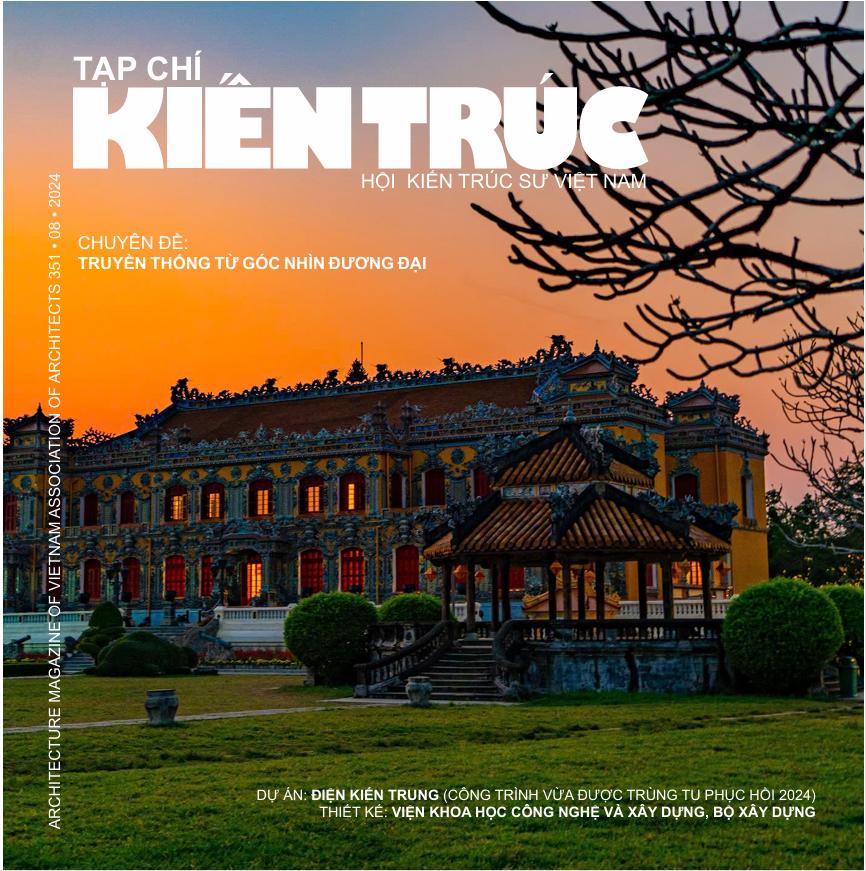
Architecture Magazine, issue 08/2024, proudly presents the special topic: “Tradition from a contemporary perspective,” with articles highlighting the exploration and promotion of traditional values within modern Vietnamese architecture, reflecting through various stages and periods of architectural development in Vietnam.
From “Modernity – Locality” to “Identity”, Vietnamese architecture has made a long and challenging journey. The articles in this issue acknowledge and evaluate the innovative efforts of the architectural community to integrate traditional architecture into new designs in various ways. Architects extract core principles from traditional architecture, such as proportions, the use of local materials, tight spatial compositions tailored to modern functions, and adaptations to local terrain, weather, and climate conditions. In recent years, Architecture Magazine has featured many architectural “portraits” and works that evoke new emotions about indigenous and traditional architecture, expressing a strong sense of identity in the language and forms of modern architecture.
Notably, the Architect’s Forum section conveys the message from the International Union of Architects (UIA) for World Architecture Day 2024: “Empowering the Next Generation in Participatory Urban Design”. This message emphasizes the restoration of urban economies, encouraging cities to grow and recover through creative and sustainable activities. In response, the Vietnam Association of Architects, as a common home for the community, is ready to connect and share, while calling on the architectural community, especially young architects, to actively engage in key tasks: shaping a sustainable and resilient urban environment; advocating for social equity and sustainable practices; participating in urban planning processes; promoting the reuse and renovation of existing structures; and integrating circular economy principles and sustainable construction activities.
The melody of the song “March on Hanoi” seems to echo in this issue, with a series of reflective articles on Hanoi’s architecture over the past 70 years, during “Days of War, Days of Peace…” This issue goes beyond the scope of a single topic, becoming a true “dialogue” between architecture and history in the memory of the community, exploring heritage spaces on a journey from the past, through the present, and into the future!
We are pleased to introduce to our readers Architecture Magazine Issue 08/2024!
Architecture Magazine
PAGE: 11
World Architecture Day 2024 – Empowering the Next Generation in Participatory Urban Design
Thu Van
With the aim of encouraging young architects to engage in urban design and planning activities, this year, the International Union of Architects (UIA) has chosen the theme for World Architecture Day 2024: “Empowering the Next Generation in Participatory Urban Design.”
World Architecture Day (WAD), established by the UIA in 1985, is celebrated annually on the first Monday of October. This day coincides with the United Nations’ World Habitat Day, highlighting the connection between the architectural community’s efforts and global urban development goals.
This theme focuses particularly on promoting the recovery of urban economies, where cities drive growth and renewal through creative and sustainable activities. The key focus areas of WAD this year include energy efficiency, waste management, the use of sustainable materials, and enhancing sustainable mobility.
PAGE: 23
Tracing the Origins of Collective Housing in Hanoi
Hans Schenk
Translated by Phung To Hanh and Trinh Duy Luan (from the original English)
Based on historical documentation of architecture and urban development from the first half of the 20th century, this article seeks to trace the origins of the ideas and practices that shaped collective housing (KTT) in Hanoi. The author follows the development of the modernist school of architecture and urban planning in Europe, focusing on the concept of the “Functional City” outlined in the Athens Charter, and the divergence and convergence of various concepts within this architectural movement. From here, the article highlights the transition of this architectural school from Europe to the Soviet Union in the mid-20th century, influenced by the political and social changes occurring there. Finally, the article traces the indirect path from Clarence Perry’s “Neighborhood Unit” to its Soviet adaptation—the mikroraion—and eventually to the formation of collective housing in Hanoi during the 1960s, emphasizing the core architectural and urban planning principle: “Socially responsible design.”
PAGE: 68
Sapa – The Evolution of Architecture and Urban Landscape from the Colonial Period to the Present
M. Arch. Tran Quoc Viet
Since its formation, the urban landscape of Sapa has undergone significant changes. Key factors influencing the image of this tourist city include the destruction of war, changes in territorial boundaries, and socio-economic development. These transformations have been the primary motivation for the authors, who are professors from the Department of Civil Architecture – Faculty of Architecture and Planning – Hanoi University of Civil Engineering, to conduct a thorough study and publish the book “Sapa: The Evolution of Architecture and Urban Landscape from the Colonial Period to the Present” in celebration of the 65th anniversary of the Department of Civil Architecture – Faculty of Architecture and Planning – Hanoi University of Civil Engineering. “This is a relatively rare study in this field,” as noted by Prof. Arch. Hoang Dao Kinh.
The book presents an impressive overview, with its main content summarized by Prof. Arch. Dubosc, President of Atelier Dubosc et Associés, France, as follows:
- A recollection of the history of the site and its surrounding landscape;
- A reevaluation of the area’s geographical and climatic features;
- A detailed analysis of the urban transformation throughout its historical progression;
- Illumination of the characteristics of the local ethnic minority communities since their discovery by the French;
- Ultimately, the book serves as a foundation for the sustainable development of the city.
PAGE: 98
55 Years of Building and Development of the Faculty of Architecture, Hanoi University of Architecture
Dr. Arch. Vuong Hai Long
The architecture formation program is oriented toward the university’s strategic vision for 2035, aiming to transform Hanoi University of Architecture into an application-oriented, multidisciplinary institution with a focus on integration and identity, grounded in human values as the foundation for sustainable development. The training of architects aligns with the university’s core values of “Ethics – Quality – Intelligence – Autonomy – Integration,” which have been recognized and highly appreciated by the leadership of the Construction sector, the Party, the State, and the public.
PAGE: 103
AIAC 2024: Acknowledging the Growth of Vietnamese Students
Dr. Arch. Nguyen Viet Huy
This year marks the 25th AIAC program, held in Mézos, France, with a notable feature: the two assigned projects have a high level of practicality, potentially to be implemented in the future. The first project, titled Coeur de Ville, aims to build a commercial and residential complex in the city center. The second project, Béguinage, focuses on constructing a residential area for the elderly, also located in the city center. The assignments this year are considered highly practical, with specific requirements regarding density, building height, and scale, combined with strict regulations on construction standards in the French Republic. This demands that students not only study the current situation of the project but also gain an in-depth understanding of and adhere to construction and planning laws. In this year’s program, students can choose one of the two projects; however, they must ensure a connection between their chosen project and the other, while also linking to the center of Mézos. AIAC 2024 features participation from eight schools representing seven countries worldwide, including Peru, Japan, South Korea, China, Thailand, Morocco, and Vietnam.