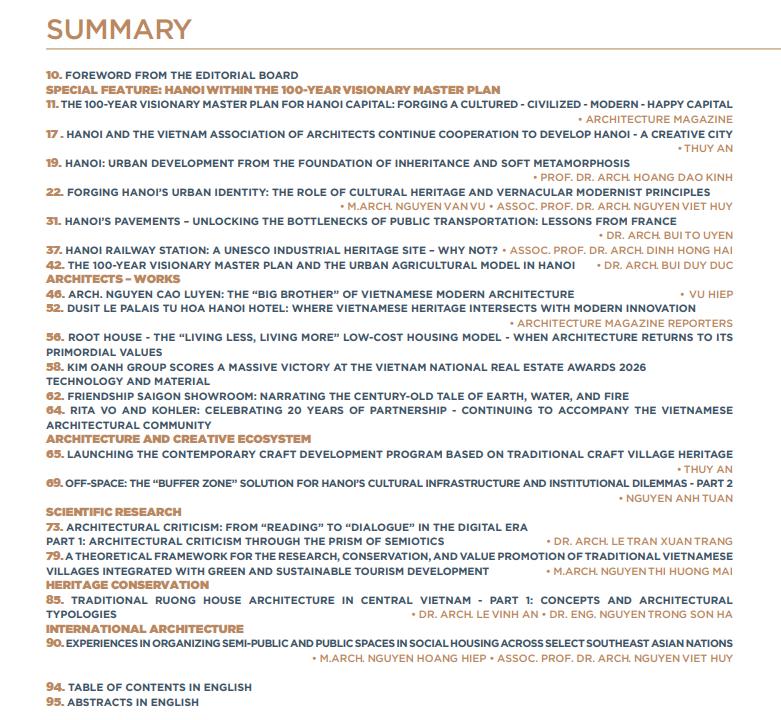
Page: 10
Foreword from the editorial board
Dear Readers,
Acting as a profound commitment to the future, the Hanoi People’s Committee recently convened to unveil the Capital’s Master Plan, simultaneously inaugurating an exhibition dedicated to Hanoi’s 100-year visionary trajectory. Accordingly, Hanoi’s ultimate destination is envisioned as a humane, modernized metropolis that impeccably preserves the ancestral soul and quintessential spirit of historic Thang Long – Dong Do, Hanoi.
The June issue of Architecture Magazine selects Hanoi as a focal point to discourse on urban acculturation-a “soft metamorphosis” of the cityscape-alongside profound inquiries posed to the architectural fraternity: How do we forge an internationally resonant future without relinquishing our national “soul” and identity? How do we continue penning the narrative of contemporary Hanoi without severing the veins of its heritage? – This paradigm shift from “conservation for preservation” to “conservation for creation” is dissected by our experts across multiple scales. They explore human-centric urban design, adaptive reuse models for the Ancient Quarter and French colonial villas, and the latent potential in transitioning between old and new spatial realms. Even the distinctive vibrancy of Kẻ Chợ’s earthen pavements is recontextualized as a seamless transitional interface, acting as a pivotal key to optimizing modern TOD (Transit-Oriented Development) public transport networks… All these perspectives converge on a core strategy: transforming heritage into a dynamic catalyst for future creation. This trajectory unveils a myriad of latent opportunities for urban spatial evolution across Vietnam.
The ensuing sections of this issue further expand our editorial horizon, tackling pressing contemporary discourses: identifying the localized opportunities and formidable challenges facing national metropolises post-consolidation, tracing historical odysseys and architectural heritage, and delving into the praxis and critical theory of contemporary architecture… We hope the evocative ideas presented in this edition of Architecture Magazine will inject a renewed vitality into the cultural acculturation process, shaping the architectural physiognomy of our nation. As beautifully articulated by Prof. Dr. Arch. Hoang Dao Kinh, this represents urban evolution rooted in inheritance, treading lightly upon nature and historical landscapes: “… Driven by conscience and vision, and elevating the cultural foundation that inherently guides the people of Hanoi, the city will ascend in modernity, elegance, and grandeur, while rigorously preserving and cultivating all that constitutes its unique intrinsic wealth.”
We proudly present to our esteemed readers Architecture Magazine Issue 06/2026!
Architecture Magazine
Page: 11
Hanoi: Unveiling the 100-Year Visionary Master Plan
• Thu Van
On June 29, 2026, the Hanoi People’s Committee convened the Conference to Announce the Capital’s Master Plan and inaugurated the Exhibition on Hanoi’s 100-Year Visionary Planning, marking a quintessential watershed in orienting the Capital’s urban spatial trajectory for the forthcoming century. Forged upon the bedrock of National Assembly resolutions, directives from the Government and the Prime Minister, and strategic orientations delineated by the Politburo regarding the construction and evolution of the Capital in a new epoch, the 100-Year Visionary Master Plan for Hanoi Capital not only promulgates a protracted development strategy but also lays the foundational cornerstone for crafting an urban metropolis that is intrinsically modern, ecological, intelligent, profoundly culturally resonant, and formidably internationally competitive.
Page: 17
Hanoi and the Vietnam Association of Architects Continue Cooperation to Develop Hanoi – A Creative City within the UNESCO Creative Cities Network
Within the vibrant framework of the Conference Announcing the 100-Year Visionary Master Plan of Hanoi Capital and the 2026 Investment Promotion, the Hanoi People’s Committee bestowed the Cooperation Agreement on Developing Hanoi – A Creative City within the UNESCO Creative Cities Network to the Vietnam Association of Architects. This was accompanied by numerous collaborative pacts with various ministries, departments, organizations, and partners, aiming to materialize the Capital’s developmental trajectory in this new epoch.
The conference stands as a monumental event, contributing to the comprehensive unveiling of major orientations, strategic visions, and spatial development plans for Hanoi over the ensuing century. It simultaneously galvanizes investment attraction and resource mobilization for the Capital’s sustainable development. Granting this Cooperation Agreement to the Vietnam Association of Architects epitomizes a profound recognition of the architectural fraternity’s role in accompanying the city to fulfill its UNESCO commitments, leveraging the intrinsic value of architecture and creative design in urban development, heritage conservation, and forging Hanoi into a premier regional creative epicenter.
Page: 19
Hanoi: Urban Development from the Foundation of Inheritance and Soft Metamorphosis
• Prof. Dr. Arch. Hoang Dao Kinh
… In the mid-20th century, Hanoi spanned nearly 100 km2. By the century’s close, it expanded to 1,000 km2. Post-2008 witnessed a sudden exponential growth, exceeding 3,000 km2. An explosive wave of construction and development radiated in all directions. The scale and architectural morphology adapted to the era. Between the old urban core and newly developed zones, conflicts emerged regarding traffic and spatial cohesion, vulnerabilities that easily lead to the gradual erosion of a quality inherently characteristic of Hanoi-the inheritance and soft metamorphosis of its history, space, and architectural form.
Yet, driven by conscience and vision, and elevating the cultural foundation that inherently guides the people of Hanoi, the city will ascend in modernity, elegance, and grandeur, while rigorously preserving and cultivating all that constitutes its unique intrinsic wealth./.
Page: 37
Hanoi railway station: A UNESCO industrial heritage site-Why not?
• Dinh Hong Hai
Should it be designated an industrial heritage site, Hanoi Railway Station would become a “goose that lays golden eggs”-This is the consensus among leading heritage and urban planning experts in Vietnam regarding the immense economic potential that a UNESCO inscription for Hanoi Railway Station, Long Bien Bridge, or the railway networks could yield, mirroring triumphant industrial heritage models globally.
Page: 42
The 100-Year Visionary Master Plan and the Urban Agricultural Model in Hanoi
• Dr. Arch. Bui Duy Duc
… Our rapid urbanization is forging a stark contrast between “affluent” residential enclaves and marginalized suburbs or slums. This dichotomy manifests in unequal resource accessibility and land acquisition practices. The housing crisis, particularly afflicting the most destitute, has catalyzed illegal land encroachment, breeding precarious, spontaneous settlements. Governmental interventions, such as social housing, remain sluggish and inadequate against this escalating crisis. In reality, within Hanoi, the spatial contestation between urban and rural realms will persist. During the conference on January 15, 2026, the Vice Chairman of the Municipal People’s Committee emphasized Hanoi’s intent to “commission” scientists to formulate an architectural framework for urban agricultural development. The Capital’s 100-year visionary master plan presents a paramount opportunity to seamlessly integrate this directive into the city’s overarching strategic matrix.
Page: 46
Arch. Nguyen Cao Luyen – The “Big Brother” of Vietnamese Modern Architecture
• Vu Hiep (conducted by)
When reflecting upon Vietnam’s inaugural generation of modern architects, one cannot overlook Arch. Nguyen Cao Luyen, whose illustrious career traversed practice, theory, and management. He was among the pioneers to establish a Vietnamese-owned private architectural firm during the French colonial era, co-founded the Vietnamese Architects’ Union (the predecessor to today’s Vietnam Association of Architects) in the Viet Bac base, and served as the Deputy Minister in charge of professional affairs at the Ministry of Architecture-He also authored seminal texts on architectural theory. Architecture Magazine proudly presents a retrospective on the life and legacy of Arch. Nguyen Cao Luyen through a dialogue between Arch. Vu Hiep and his descendants: Educator Nguyen Truong Luyen (son) and Arch. Nguyen Tri Thanh (grandson).
Page: 65
Launching the Contemporary Craft Development Program Based on Traditional Craft Village Heritage
• Thuy An
Within the framework of the Hanoi Festival of Creative Design 2026, Hanoi has officially inaugurated the Contemporary Craft Development Program Based on Traditional Craft Village Heritage, commencing with the opening event: The 2026 Creative Matchmaking Market (held over two days, June 13-14, at Vincom Mega Mall Royal City). This visionary initiative, co-proposed by the Hanoi Department of Culture and Sports and Architecture Magazine – Vietnam Association of Architects, aspires to cultivate a synergistic ecosystem interlinking artisans and traditional craft villages with designers, artists, academic institutions, enterprises, and the broader creative community. Through this collaborative nexus, the program aims to incubate contemporary handicraft products that profoundly encapsulate Vietnamese cultural identity within the modern milieu.
Page: 69
OFF-SPACE: The “Buffer Zone” Solution for Hanoi’s Cultural Infrastructure and Institutional Dilemmas – Part 2
• Nguyen Anh Tuan
Abstract: Hanoi’s induction into the UNESCO Creative Cities Network in 2019 stands as a pivotal milestone, yet it lays bare a glaring paradox: while the artistic milieu is experiencing a renaissance, the physical infrastructure dedicated to it remains deficient and fragmented. Grounded in personal observations and experiential insights, this paper postulates a strategic approach via the “Off-space” (independent/alternative art space) paradigm. This relies upon a public-private partnership mechanism: capitalizing on surplus public land and assets while harnessing the agile governance capabilities of the private sector, all whilst ensuring harmonious alignment with the Capital’s political, cultural, and social developmental trajectories.
The article comprises two segments. Part One delineates a synoptic overview of the infrastructural landscape for creative culture in Hanoi alongside three European off-space case studies, where spaces coalesce driven by the urgent imperatives of the local creative community, bolstered by institutional and corporate support. Part Two elucidates two Asian exemplars wherein off-spaces are institutionalized to engender creative realms responsive to holistic development strategies. It culminates in an analytical exposition of a developmental strategy tailored for Hanoi, alongside an appraisal of prevailing challenges and barriers.