Page: 10
Foreword from the editorial board:
Dear readers,
Architecture Magazine Issue 6/2024 proudly presents to you stories of contemporary urban architecture. From pressing societal issues to the contributions of architects, this is a continuous evolution that never ceases. Within this process, there is always interaction, connection, and the dynamic and creative exchange between generations of architects.
The portraits of architects and the exemplary architectural projects featured in this issue will be special highlights—from the veteran architects to the young talents making their mark in international architecture competitions, all representing the bright future of Vietnamese architecture.
A journey through art in the “Ancient Village Cluster of Èze” will close this issue of the magazine, serving as a beautiful conclusion to the dialogue between art and architecture—this also reflects the spirit of the Hanoi Creative Design Festival, which is being launched with the collaboration of the Vietnam Association of Architects, the Hanoi People’s Committee, and creative partners.
With its diverse, multidisciplinary perspectives, Architecture Magazine hopes to foster multifaceted connections between the professionals and society, aiming to achieve the common goal of creating intelligent, modern, and culturally rich cities.
We proudly present to our readers Architectural Magazine Issue 06/2024!
Architecture Magazine
Page: 23
Interview with Prof. Dr. Arch. Doan Minh Khoi: “Architecture is the Sum of Art and Technology”
Conducted by Arch. Vu Hiep
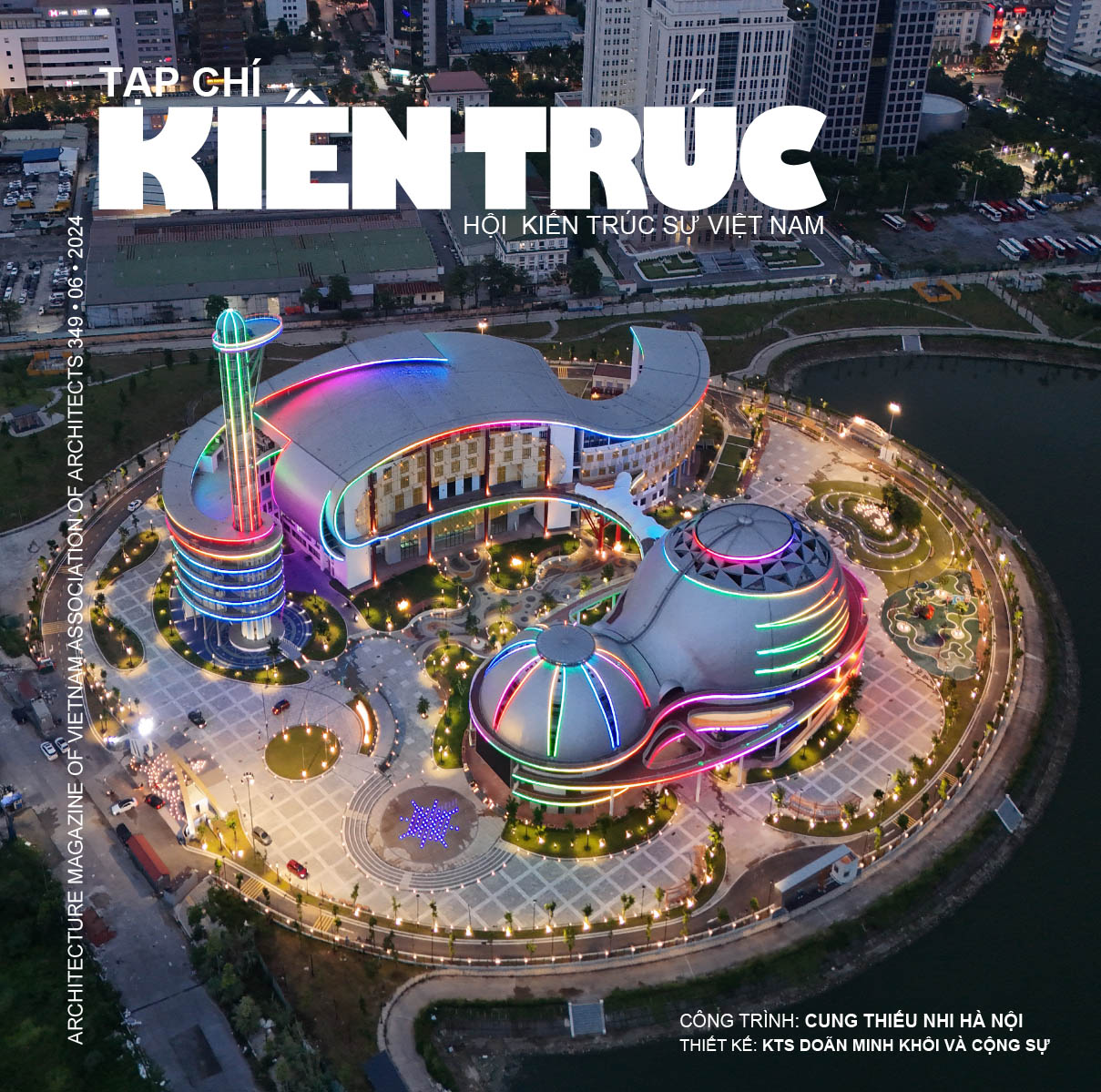
Architecture is a multidisciplinary profession that requires various skills: creativity, management, negotiation, calculation, presentation, etc. The age of success for architects is often later than in other artistic fields. Prof. Dr. Arch. Doan Minh Khoi, now in his seventies, remains as passionate about his work as ever. He is well-known as a diligent researcher and a dynamic educator who has often experimented with advanced training methods and models from developed countries adapted to Vietnamese conditions. Recently, his design for the Hanoi Children’s Palace was completed, allowing the public and the Vietnamese architectural community to see Doan Minh Khoi more clearly in his role as a practicing architect. The Architecture Magazine is pleased to present an interview between Arch. Vu Hiep and Prof. Dr. Arch. Doan Minh Khoi about his journey in studying, teaching, researching, and practicing architecture.
Page: 32
Landmark Landscape Projects Promoting Tourism Development
Dr. Arch. Pham Anh Tuan
In each period, new works being born always bear the mark and breath of the times. These works not only contribute to breakthroughs in design and construction but also help preserve the values for the development history of human society in general and the history of (landscape) architecture development in particular. Alongside historical, landscape, and environmental values, famous architectural works and distinctive landmark landscape projects, which are associated with traditional cultural significance, always attract the attention of the community, strongly promoting service activities and the tourism development of the locality.
Page: 62
Unique 18th-Century Architectural Art of Van Cat Mother Goddesses Temple
Assoc. Prof. Dr. Trang Thanh Hien
Located within the architectural complex dedicated to the Mother Goddesses at Phu Day—an important center of Mother Goddesses worship in Nam Dinh province, Van Cat Mother Goddesses Temple is a rather unique architectural work dated back in the 18th to 19th centuries. This can be considered the most remarkable architectural work that has preserved many values, from the architectural landscape to the wooden architectural components as well as the stone carving art. When compared to the architectural art of Mother Goddesses temples in general, with other centers of Mother Goddesses worship in Northern Vietnam such as West Lake Temple (Hanoi), Nap Temple, Tien Huong Temple (Nam Dinh), and Tay Mo Temple (Thanh Hoa), Van Cat Mother Goddesses Temple is perhaps the work that best retains beautiful and ancient architectural and planning marks to this day.
Page: 73
Architectural Model for Bus Stops in Hue City
Nguyen Ngoc Tung , Nguyen Hoang Nhat Quyen
Truong Van Duong , Thai Tran Nhat Minh
In recent years, traffic congestion in Hue City has been increasing, while the use of the public transportation system remains limited. However, with urban development, the public transportation system, including buses, will become an indispensable component in the future. In Hue City, the use of bus transportation is still limited due to several reasons such as the habits of the residents, the convenience level of the bus system, the design of bus stops, and the spatial distribution system of bus routes, among others. This article focuses on analyzing the current situation and proposing an architectural model for bus stops, thereby contributing to the development of public amenities in Hue City.
Page: 82
Factors Influencing the Use of Informal Learning Spaces by University
Students
Nguyen Thuy Trang , Nguyen Thi My Hanh
Nguyen Tien Manh , Nguyen Diep Linh
In recent years, the trend in redesigning and constructing new universities around the world has been tending to optimize campus spaces to meet the growing demand for student activities related to learning and social interaction outside the classroom. In many countries, a concept has been established for this type of learning space—Informal Learning Spaces (ILS), as opposed to Formal Learning Spaces (FLS) such as traditional classrooms and lecture halls. Numerous in-depth studies have demonstrated that intentional design of these learning spaces has a positive impact on students’ learning outcomes.
Page: 90
The Ancient Village of Eze: Where Architecture and Art Converse – Part 2: A JOURNEY WITH ART
To Hai , Quoc Minh
Before any journey, one often wonders if the destinations will meet their expectations. And it’s challenging for me to convey how the beauty of the ancient village cluster of Èze in southern France has surpassed every expectation. It is unexpectedly magical and enchanting. Therefore, people call this the land of art, a rendezvous for artists and creators. Its inherent charm is naturally fragrant in a captivating romantic setting. It’s hard to describe accurately how art resonates with time, space, and people here. Every step brings a fresh, distinct breath. “Discovering art in Èze” (including the villages of Saint-Paul-de-Vence, Roquebrune-Cap-Martin, Èze-Bord-de-Mer…) has become a phrase used by art enthusiasts when talking about the experience of this place.