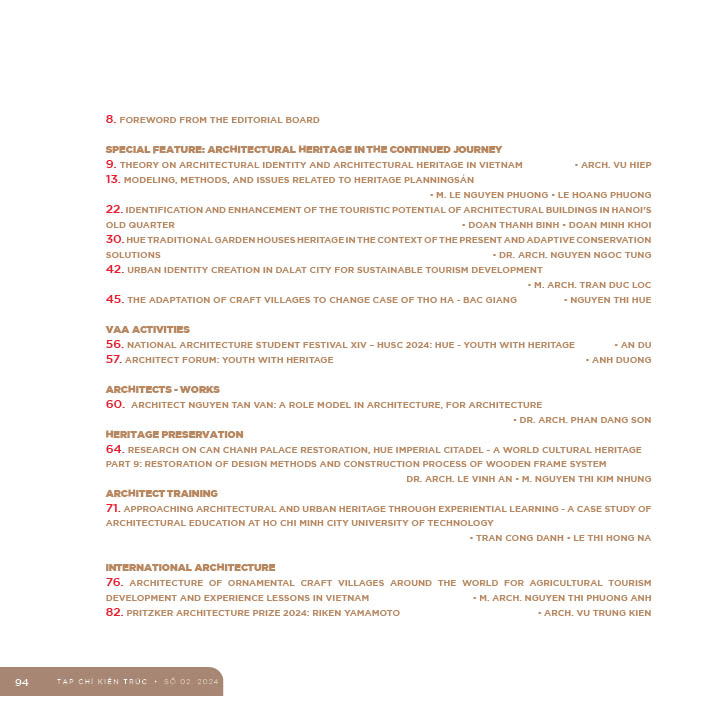
Page: 8
Foreword from the editorial board:
Dear readers,
With the theme “Flow,” the 2023 Hanoi Creative Design Festival (organized by Hanoi People’s Committee, Vietnam Association of Architects, Department of Culture and Sports, Architecture Magazine, Vietnam Railways Corporation in collaboration with many accompanying units such as UNESCO, UN-Habitat…) focused on three main pillars: Design, Community and Creativity – Aimed to ignite the vital flow connecting the historical, cultural, economic, and historical values of the Capital, creating experiences that transform industrial heritage into new services and products, attracting investment, implementing strategies for sustainable cultural industry development.
Following this theme, Architecture Magazine (AM) issue of February 2024 is pleased to introduce readers to interesting content revolving around the journey of awakening heritage by architects and emerging creative cities nationwide. Heartfelt articles succeeded in truly conveying the message of this profession: Not only to preserve heritage, but more importantly, it is necessary to creatively transform heritage, to unleash the value of heritage to adapt to modern life. This is also part of the content of the Architecture Student Festival that will take place in Hue at the end of April with the theme: “Hue – Youth with Heritage.”
Other sections in AM continue to explore different perspectives: From a craft village with adaptive development steps to heritage planning models and methods; from heritage preservation for tourism development to urban identity creation towards sustainability… It is hoped that AM will inspire many useful ideas and information for readers about architectural heritage in the flow of development.
The Pritzker Architecture Prize 2024 will conclude this issue of AM with a portrait of this year’s laureate architect: Riken Yamamoto, from Yokohama, Japan – ” Yamamoto develops a new architectural language that doesn’t merely create spaces for families to live but creates communities for families to live together. His works are always connected to society, cultivating a generosity in spirit and honoring the human moment.” – Beyond existing values, these are the spiritual values of the works of architect Riken Yamamoto that have been recognized and honored with the highest architectural award.
We proudly present to our readers Architectural Magazine Issue 02/2024!
Architectural Magazine
Page: 9
Theory on Architectural Identity and Architectural Heritage in Vietnam
Arch. Vu Hiep
Nearly 50 years since the country’s reunification and nearly 40 years of renovation, Vietnamese architecture has made significant progress, with expanded urban areas, increasingly completed infrastructure, splendid and modern buildings, upscale and luxurious resorts, and industrial zones bustling with production around the clock. However, architectural theory and critique have not developed in proportion to the reality of the architectural profession and the societal context. This has led to some degree of confusion within the architecture community, as well as endless debates about projects deemed “foreign,” “soulless,” or those that disrupt the sustainable spatial structure of urban and rural areas, or improper cases of heritage preservation and renovation projects. The development of theory and critique in the field of architecture in particular, and in the field of literature and art in general, is not an overnight process, but it requires early attention and nurturing, based on the achievements of past generations as well as new knowledge from the contemporary world. This article will address two important issues in the architectural theory of our country from 1975 to the present: Architectural Identity and Architectural Heritage.
Page: 22
Identification and Enhancement of the Touristic Potential of Architectural Buildings in Hanoi’s Old QuarterDoan
Thanh Binh – Doan Minh Khoi
The Old Quarter of Hoan Kiem District has always been a tourist attraction not only for Hanoi city but also for Vietnam as a whole. In recent years, under the influence of the market economy and the demand for strong economic development, the face of the old streets has undergone many changes, with many buildings deteriorating, while others have been renovated, refurbished, or even demolished to make way for new construction. In order to preserve the traditional, cultural, and historical beauty of the area, and at the same time to meet the needs of economic and social development, especially in promoting tourism, it is necessary to help the community recognize the cultural and historical values of the buildings within the space of the streets and their surrounding areas. Understanding and appreciating the values of traditional business activities and architectural heritage will lay the foundation for developing sustainable tourism directions for the Old Quarter, providing safe and friendly tourism guidance for visitors.
The article is a comprehensive study based on current surveys, comparative analysis of documents, guidelines, and practical design experiences of projects in the Old Quarter area. It aims to provide evaluation schemes, identify the values of old streets and buildings along these streets, aiming towards sustainable development to enhance Hanoi’s tourism economy.
Page: 30
Hue Traditional Garden Houses Heritage in the Context of the Present and Adaptive Conservation Solutions
Dr. Arch. Nguyen Ngoc Tung
The Nguyen dynasty’s regulations, cultural lifestyle, religious beliefs, feudalist ideologies, and geographical-climatic characteristics of Hue have influenced the formation and organization of space, the architectural forms, and the living environment of the Hue Traditional Garden Houses (HTGH). These factors have created a unique characteristic that traditional houses in other cities cannot possess. In recent years, many HTGHs have gradually disappeared or been distorted under the influence of urbanization, economic pressure, population growth, natural disasters, floods… This article introduces the architectural characteristics of HTGHs, the current situation, and proposes some adaptive conservation solutions.
Page: 42
Urban Identity Creation in Dalat City for Sustainable Tourism DevelopmentM.
Arch. Tran Duc Loc
The article addresses the issue of creating a sustainable urban identity to prioritize the development of tourism in Dalat (and vice versa) in order to identify the core values for the city, crystallizing the inherent cultural characteristics of the place. From there, it suggests strategic directions for the development of tourism in Dalat… based on compliance with the strategic economic development orientation, comprehensive planning, and the formulation of investment attraction policies in the tourism sector in a creative manner.
Page: 45
The Adaptation of Craft Villages to Change Case of Tho Ha – Bac Giang
Nguyen Thi Hue
Abstracts:
Cultural change in general, village culture change and craft village culture in general is an inevitable trend of modern history, especially in the current period, cultural change is one of the factors changing the appearance of traditional craft villages in our country. At the same time, cultural change is the condition for craft villages to change, survive and develop on different scales and levels. This is an objective law and occurs in many aspects of material and spiritual life. Bac Giang is a land of civilization and is close to the capital Hanoi, with conditions for development, especially the development of traditional craft villages. In fact, the current process of industrialization and modernization has been creating great impacts, opportunities and challenges on the lives of people in rural villages in general as well as in traditional craft villages. in Bac Giang in particular. This process is essentially the process of rural urbanization, leading to inevitable consequences that will take place in today’s traditional craft villages. Many craft villages are no longer active or have been eroded due to many different reasons, while craft villages are still transforming to survive and develop. To maintain and develop craft villages, people always have to change product designs, improve production processes, apply advanced technology in some possible stages, search and expand markets… to meet the needs of people in the new era.
Page: 64
Research on Can Chanh Palace Restoration, Hue Imperial Citadel – A World Cultural Heritage: Part 9: Restoration of Design Methods and Construction Process of Wooden Frame System
Dr. Arch. Le Vinh An, M. Nguyen Thi Kim Nhung
Following the previous research articles, through document research, the article aims to analyze architectural proportions, interviews with traditional carpenters, experience gathered over 20 years of cultural heritage conservation work, and technical experience in restoring the architectural heritage of Hue Imperial Citadel. This research aims to propose the restoration of design methods and construction processes of the wooden frame system of Can Chanh Palace. It is hoped that this study will provide a useful scientific and practical basis for the restoration project of Can Chanh Palace, Hue Imperial Citadel – a World Cultural Heritage.
Page: 71
Approaching Architectural and Urban Heritage Through Experiential Learning – a case study of architectural education at Ho Chi Minh City University of Technology
Tran Cong Danh, Le Thi Hong Na
The application of advanced teaching methods by lecturers will help students access knowledge more easily, be more proactive in their studies, and ultimately aim to improve the quality of human resource training at universities. Experiential learning (EL) aims to develop students’ competencies related to practice and plays an important role in bridging the gap between the quality of education and the needs of the labor market. This is an approach for lecturers to design and implement teaching towards maximizing students’ experiential activities depending on each real-life context. For training architecture students, the EL method is appropriate and very useful, especially for content related to architectural and urban heritage. This article presents some experiences in applying the EL method in the process of teaching architecture at the Ho Chi Minh City University of Technology (HCMUT) through a typical case study, the course “Internship in Architectural and Urban Heritage”.
Page: 76
Architecture of Ornamental Craft Villages Around the World for Agricultural Tourism Development and Experience Lessons in Vietnam
M. Arch. Nguyen Thi Phuong Anh
Hong Van Ornamental Creatures craft village (OCCV) is a village specializing in the production and business of ornamental creatures (OC). LSVC gathers many skilled artisans with rich techniques and arts in cultivating diverse OCs such as planting trees, arranging landscapes, creating unique bonsai products, breeding ornamental animals such as ornamental birds and fishes, etc. OCCV with high economic value products has turned OC activities into a green economic sector, contributing to poverty reduction, environmental improvement in rural areas, as well as ecosystem balance. The development of LSVC is associated with agro-tourism activities, not only bringing economic benefits, solving employment problems for local laborers but also contributing to preserving and promoting the cultural values of the nation. The organization of OCCV architectural space to serve agro-tourism development has been studied and successfully implemented in many countries around the world, bringing economic value and promoting the national tourism image such as Canada, France, the Netherlands, Thailand, Japan… Based on the analysis and evaluation of some models of OC architectural space organization around the world to serve agro-tourism development, the article proposes some lessons learned to develop agro-tourism in Vietnam, contributing to enhancing the effectiveness of exploiting OCCVs in our country.