

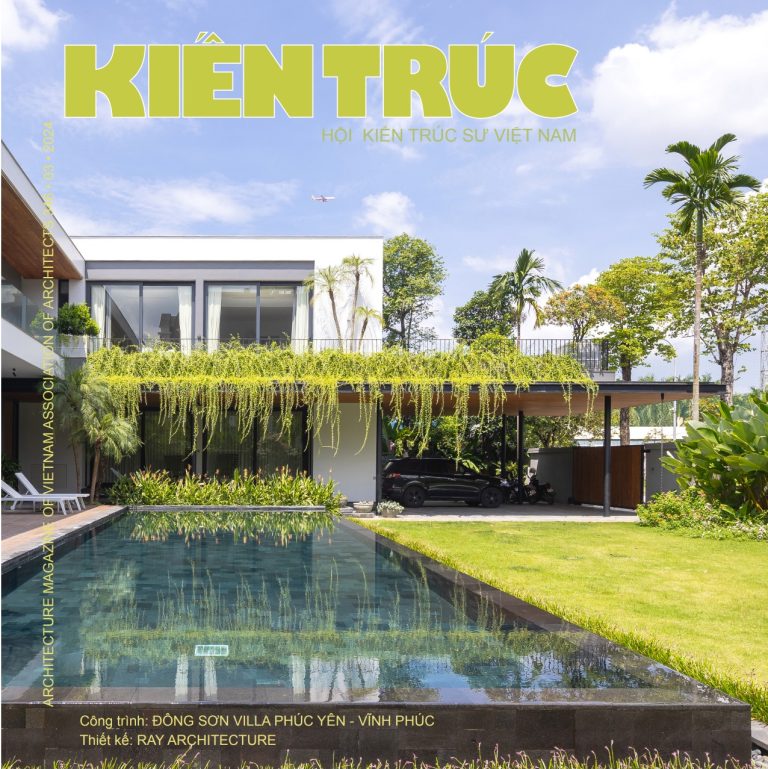
Page: 8
Foreword from the editorial board:
Dear readers,
In the month of April, the architectural community in Vietnam turns vibrant as we approach the commemoration of Vietnam Architecture Day. Let us remember the words of President Ho Chi Minh at the establishment conference of Vietnam Association of Architects 76 years ago (April 27, 1948): “Among the four essential needs for people’s lives: dwelling and traveling are as necessary as eating and clothing. Therefore, architecture is of great importance… I hope the conference will come up with practical plans in line with the current situation and forward-looking architectural programs… Especially in the issue of rural housing, to find simple, high and dry, luminous, and affordable housing types.”
The March 2024 issue of the Architecture Magazine carries out a special feature “50 years of housing architecture in Hanoi (1975 – 2025)” in collaboration with the Hanoi Department of Urban Planning and Architecture and the Department of Culture and Sports of Hanoi. This feature gathers articles identifying the remaining problems, challenges, specific development factors, as well as opportunities… aiming to propose planning directions and development of Hanoi’s architecture in general and housing in particular with a vision to 2045. This is also an important content of the State-level program “Reviewing 50 years of Vietnamese architecture 1975 – 2025” implemented by the Vietnam Association of Architects, towards establishing the development orientation of modern Vietnamese architecture with a vision to 2045 – the 100th anniversary of the country’s founding.
The Architecture Magazine’s March 2024 issue brings readers special emotions with activities commemorating Vietnam Architecture Day across the country. Remembering the glorious history pages where many generations of architects proudly accompanied the country’s common development, young architects would understand more, love more, and join hands in building the Common Home of the Vietnamese architectural profession.
Page:9
Identifying Residential Architecture in Vietnam from 1975 to 2020 (Part 1)
Towards the Review of 50 Years of Unified Vietnamese Architecture
Arch. Tran Thanh Binh
Identifying Residential Architecture in Vietnam from 1975 to 2020 provides a general assessment of the development of residential architecture, as one of the important components of Vietnamese architecture since the reunification of the country. Based on an overview analysis of the political, economic, and social contexts and the main influencing factors such as the situation of residential architecture in Vietnam before 1975 and the trends of contemporary residential architecture worldwide, the article attempts to depict the overall picture of the development process of residential architecture in Vietnam through different periods, associated with important milestones. It aims to provide a preliminary general overview of the characteristics, trends, and certain representative works of residential housing, mainly in Hanoi and Ho Chi Minh City.
Following the idea of Assoc. Prof. Dr. Dinh Hong Hai.
Page:15
Architecture of Residential Houses In Hanoi – Which Model Is Suitable for the Future
Dr.Arch. Phan Dang Son
Building and developing residential housing on the existing heritage foundation, along with forming new residential areas for the future of Hanoi, is a vital task if the city wants to develop successfully and sustainably. Establishing and implementing this program requires the coordinated efforts of all levels of government, professional experts, and the community. The approach should begin with a comprehensive review program with clear qualitative and quantitative assessments from the overall scale to the details. Then, from this review, plans, directions, necessary actions, and standardized procedures for the future can be derived.
Page: 22
In Situ Resettlement Model for Old Residential Areas in the Inner City of Hanoi
Dr.Arch. Nguyen Thu Huong
Dr.Arch. Nguyen Hoai Thu
Re-establishing the in situ resettlement model for old residential areas in the inner districts of Hanoi is a revolutionary task aimed at creating a civilized urban space and improving the comprehensive quality of life for residents. Based on the evaluation of the current situation in specific areas, the authors propose systematic solutions ranging from objectives, perspectives, models to spatial organization solutions. The core solution of the in situ resettlement model is to generate “Material capital” and “Social capital” for the community. By harnessing these resources, coupled with community consensus, it will be a sustainable approach to renovating old residential areas in the inner city of Hanoi. From there, this model can be replicated in similar urban areas across Vietnam.”
Page:30
Exploring the Creative Space Positioning in Collective Housing Areas
MSc. Tran Hau Yen The
In this article, through analyzing several artistic projects taking place in collective housing areas over the past 10 years, the author aims to affirm the heritage value of these collective housing complexes, particularly exploring the potential of cultural-commercial spaces here. Collective housing areas are not only spaces imbued with nostalgia, as a symbol of the North Vietnam during the 1960s and 1970s, but also public spaces with potential for the development of creative industries and the creative economy of the capital city.
Page: 57
Solutions for Organizing Housing in Military Camps on Islands
M. Arch. Bui Thi Kim Dung
The article presents a couple of solutions for organizing living spaces in military camps on Vietnamese islands in a specialized direction. It has solved the problem of form and function to meet the training requirements of soldiers. In addition, ecological factors, materials, water surfaces, greenery, ventilation, and natural lighting are also addressed. For areas prone to strong winds and harsh, unpredictable climates, reasonable communal living solutions are essential more than ever. Within the scope of the article, the author hopes to contribute to the planning ideas for military camps to improve the living quality of soldiers, thereby helping them feel assured in their work in the sacred sea and island areas of the homeland.
Page: 63
Passive Design Solution for Low-Rise Housing in the Coastal Area Kien Giang
Le Thi Hong Na
Le Thai Bao
Sustainable development is the key goal that most current architectural trends are aiming for. To achieve that goal, energy saving in buildings is always a priority issue for careful consideration during the design process. Among the many solutions aimed at reducing energy use, passive design is given top priority and provides long-lasting effects throughout the life of the building. This study aims to propose architectural solutions for low-rise housing in the coastal area of Kien Giang following passive design. Among them, the sea reclamation urban area in the Northwest of Rach Gia City was selected for analysis and proposed as a typical case.
Page: 82
Architecture Students: Thoughts & Aspirations
Arch. Doan The Trung
Arch. Nguyen Manh Tri
Improving the quality of architecture education is a pressing demand of society. However, this is also an extremely complex issue. Through their research, the authors do not aspire to provide any specific conclusions about the direction or propose changes to the current education system. Instead, we can aim for a deeper and more comprehensive understanding of the aspirations and changing thoughts of architecture students throughout their formation process. From there, it is hoped that managers will have a holistic view of current architectural education and propose appropriate innovative policies to bring Vietnam’s architecture formation programs closer to the standards of the region and the world.
Page: 89
Garden of Zen Canon – Ryoanji Temple
Nguyen Su
Ryoanji Temple, also known as The Temple of the Dragon at Peace, is a temple of the Myōshin-ji school of Rinzai branch of Zen Buddhism. The Zen garden of this temple can be considered the most famous Zen garden in Japan. However, to this day, questions about the history of the temple remain an unanswered puzzle.
Gardens, always enclosed in some preconceived notion, are similar to flower gardens: we deem that they must have general islands or rock islands, or flowers. When seeing such gardens, it is difficult to label them as flower gardens. The ultimate appreciation of art is to eliminate prejudice. Those who have nothing still have prejudices, and those with more knowledge have even more prejudices. Appreciating the Ryoanji Temple requires, first and foremost, the elimination of prejudice. Stepping into the garden, without thinking of anything else: We must not look outside the garden, but look inside the garden.





