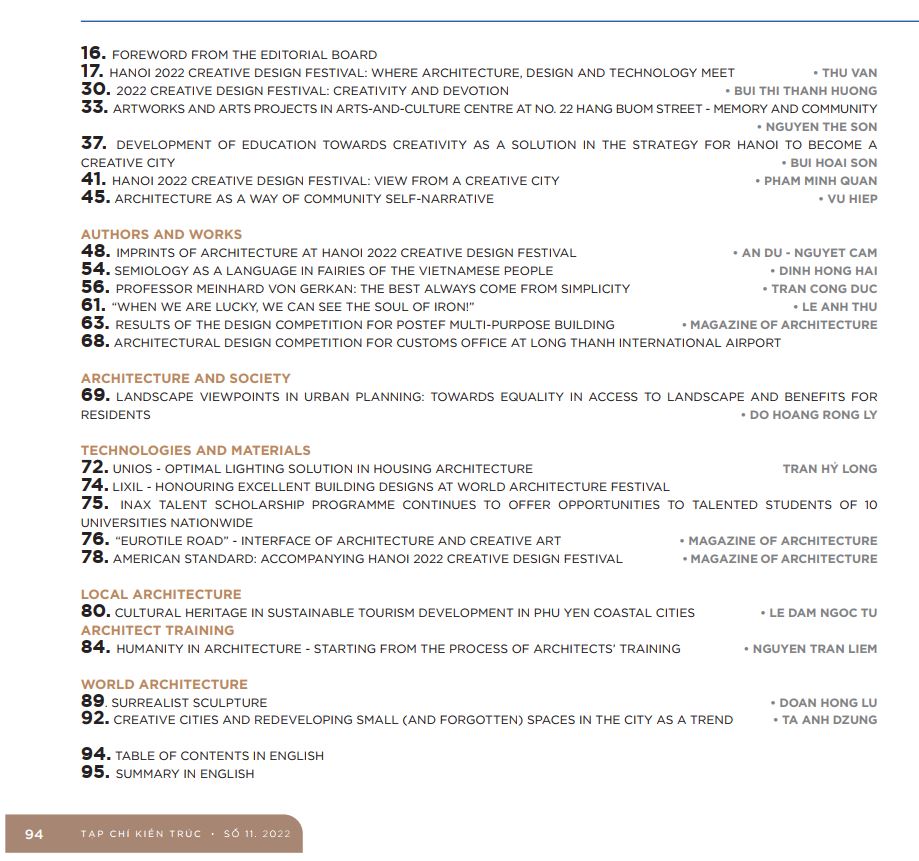
Page: 16
FOREWORD FROM THE EDITORIAL BOARD
Our dear Readers,
As we all know, Creative City is a major development policy and Hanoi officially registered to become a member of UNESCO’s Creative Cities Network (UCCN) in 2019. The Creative City Development Strategy does not only promote Hanoi’s cultural resources but will also disseminate the creative spirit in all sectors, including politics, culture, economy, society, technology and many more. For that reason, Hanoi Creative Design Festival 2022 co-ordinated by Hanoi City People’s Committee and Vietnam Association of Architects and co-organised by Hanoi City Department of Culture and Information, the Magazine of Architecture – Vietnam Association of Architects and other partners: UNESCO, UN Habitat, Hoan Kiem District People’s Committee, Hanoi Trade Promotion Centre took place in mid-November 2022. It was a successful event that could be used to evaluate Hanoi’s development towards creativity and sustainability.
In this Special Issue – October 2022, the Magazine of Architecture would like to introduce to readers the highlights of Hanoi Creative Design Festival 2022 with the theme “Design and Technology”. The message of Vietnamese architects “Creating for the community” has becomes the core content, helping to connect and disseminate the creation of contemporary art to the public of the Capital City. This is the second time, after the Innovation Week 2021, the Magazine of Architecture – Vietnam Association of Architects – together with the professionals has worked together with the designers in Hanoi from various areas to bring vitality and represent a remarkable change in Hanoi’s development orientation
for the future with “Culture” and “Creativity” as the two key points.
The dialogue entitled “Authors and Works” with impressive spaces for exhibition, new creative designs, etc. introduced in this special issue will provide readers with new perspectives. These do not only contribute to the establishment of a network connecting creativity in Hanoi but can also step by step promote interdisciplinary creativity and cultural diversity, with the participation of many people from various sectors and regions, demonstrating the interaction among the four: State – Enterprise – Artist
– Community. Certainly, this is a long-term work plan that requires social cooperation, and we are proud to have already taken the first steps of transformation, so that Hanoi can show its cultural values and become a true model of development and make creativity a goal for the whole country to strive for. We are working together to realise the ideas of building Hanoi into a “meeting point” for culture and creativity in the future!
We would like to thank you all, the readers, Hanoi City Department of Culture and Sports, UNESCO international organisations, UN Habitat, Hoan Kiem District People’s Committee, Hanoi Trade Promotion Centre; Hanoi University of Architecture, Hanoi University of Civil Engineering, Faculty of Interdisciplinary Sciences – Hanoi National University, Hanoi University of Fine Arts, Hanoi University of Science and Technology; along with sponsors: Eurotile Brand, Lixil, Phenikaa Lighting Brand, Sovico Group, Mailand Urban Area – Hanoi City, Vietnam Construction and Import/Export Joint Stock Corporation – Vinaconex and partners. Our special thanks also go to the artists, architects, photographers, designers, etc. who have accompanied us to carry out this special programme. See you next time and let’s work together for creativity and become brilliant!
Page: 37
DEVELOPMENT OF EDUCATION TOWARDS CREATIVITY AS A SOLUTION IN THE STRATEGY FOR HANOI TO BECOME A CREATIVE CITY • BUI HOAI SON
Education towards creativity is the key issue to consider because creative citizens are the most important resource for a creative society and a start-up country. Therefore, in the strategy of developing Hanoi
into a creative city, education towards creativity needs to be regarded as one of the essential solutions, so that the spirit of creativity can be wellreceived and Hanoi deserves the special recognition of UNESCO as a member of the UNESCO Global Creative Cities Network.
Page: 45
ARCHITECTURE AS A WAY OF COMMUNITY SELF-NARRATIVE
• VU HIEP
In Vietnam cities are developing rapidly, but there are no new attractive narratives. That is why the state has to “chase” real estate projects implemented by large corporations to adjust the planning. In that
somewhat “confusing” context, we must emphasise and affirm the role that the state should play: commanding and leading in planning, urban design, and architecture, especially when it shows that private corporations only think about benefits but they take almost no responsibility for the society.
Is it time for a large-scale architectural project run by the state to tell the story of Vietnam in the modern time?
Page: 69
LANDSCAPE VIEWPOINTS IN URBAN PLANNING: TOWARDS EQUALITY IN ACCESS TO LANDSCAPE AND BENEFITS FOR RESIDENTS • DO THI LONG LY
The natural landscape is really a factor that shapes human living environment. It develops over time and is regarded as a true reflection of the time and the society in which we live, as well as the way of life we practise. It is a unique benefit, ecologically considered, a kind of social product and a culture, as well as a memory that can bring us emotions and feelings of happiness, satisfaction or nothing. Therefore, it is undeniable that landscape needs to be given a priority in the sustainable city development. Landscape is considered a matter of perception, established and created from the relationship between humans and the natural environment. Natural landscapes can be managed and claimed as a civilian right, which helps deal with social conflicts, in the orientation, development and conservation of the natural environment in cities, thereby improving the quality of life and the attractiveness of the territory, ensuring equality of welfare for all people. Above all, the cohesion of local residents with the territorial planning, including the planning of natural landscape, should be established through dialogues, consultations and exchange activities in projects and local construction planning policies.
Page: 84
HUMANITY IN ARCHITECTURE – STARTING FROM THE PROCESS OF ARCHITECTS’ TRAINING • NGUYEN TRAN LIEM
Architecture is shaped by people and meets the needs of people. The human factor plays a very important role in the formation of the so-called spiritual life in architecture. As a subject of creativity, architects with a humanistic perspective will be key actors in starting the entire design process and creating a humanistic architecture. The issue of humanising the training process so that architects will soon be able to understand the concept of humanistic design at school should be raised as a serious question. That is the core content that the author introduced and analysed in depth, and used a number of highly appreciated projects as evidence. The author was supervisor of those award-winning students.
Page: 89
SURREALIST SCULPTURE • DOAN HONG LU
Surrealism is a tendency in the art that derived from Symbolism and psychoanalysis, which places irrationality above all reasons. This trend aims to liberate people from all shackles and constraints in the society. People can feel free to express their individual thoughts, and they should not be prevented or enchained by reasons, logics, morality, aesthetics, economics or religions. The artworks of Surrealist artists reflect all the constantly changing psychological states in the subconsciousness, regardless of reality or dream, sensible or insensible, right or wrong.
Xem thêm: https://www.tapchikientruc.com.vn/tap-chi-kien-truc/tap-chi-kien-truc-so-11-2022.html
© Tạp chí Kiến trúc