Page: 14
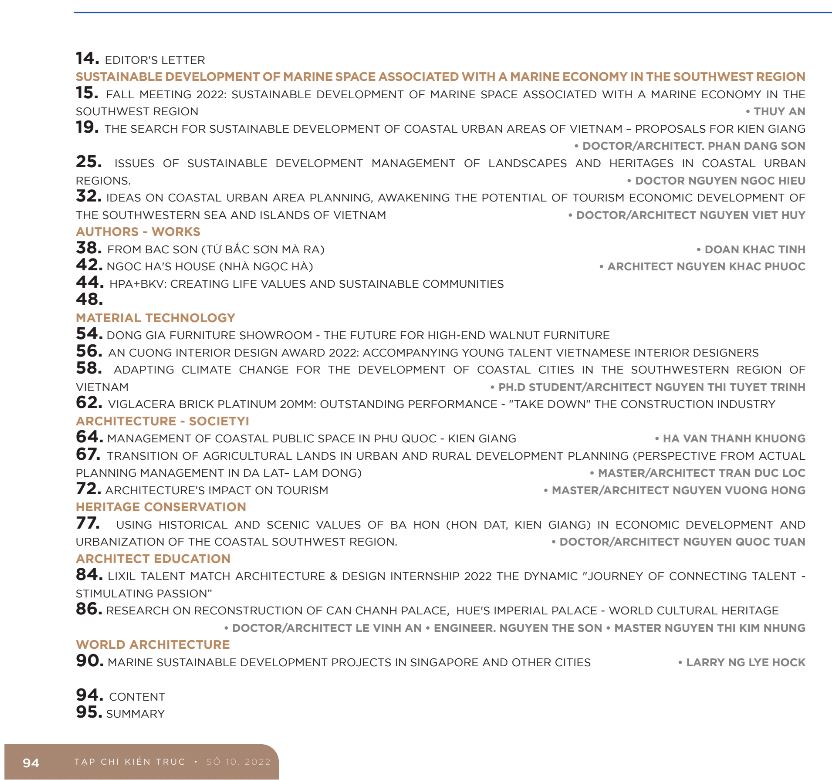
Editor’s Letter
Dear Readers,
Vietnam is a coastal country with 3260 km of coastline. The coastal areas converge diverse and rich natural resources with marine ecosystems that need to be conversed and preserved for a long time. In recent years, the study of architectural planning of coastal provinces, promoting the potentials and advantages of the regions, and contributing to economic development and marine tourism towards sustainability and adaptation to climate change, has attracted the attention of the architecture community and become an important mission of the Vietnam Association of Architects.
Architecture Magazine’s November issue is a special edition on “Sustainable development of marine space associated with a marine economy in the Southwest region”. This is also the main content of the Science Conference – Fall Meeting 2022 with the convergence of domestic and foreign architectural and planning experts to analyze, evaluate and propose specific solutions, contributing to the constructions of coastal cities toward Modern – Green, and Sustainable Development.
Considering valuable lessons from the world and neighboring countries, the solutions proposed on this issue are consistent with the direction of developing coastal urban areas in association with coastal economic zones on the principle of non-polluting and ensuring effective adaptation to climate change. Believing that, focusing on implementing several key solutions will contribute to the improvement, renovation, and development of the coastal tourism system in the Southwest region towards sustainability, thereby making a more positive contribution to the development of socio-economic development in the regions and the development of coastal tourism in Vietnam.
Page: 19
THE SEARCH FOR SUSTAINABLE DEVELOPMENT OF COASTAL URBAN AREAS OF VIETNAM – PROPOSALS FOR KIEN GIANG
Doctor/Architect Phan Dang Son
The legislative aspect of the coastal urban area development of Kien Giang is relatively adequate. However, sea encroachment, one of the main tasks when developing coastal urban areas, is still facing a gap: The State does not have specific regulations on the management and exploitation of land in sea reclamation zones, including in coastal urban areas and other areas. Another national problem is that the national master plan has not been approved, accordingly, the strategic goals, as well as the “qualitative” and “quantitative” limitations for each coastal urban area, including urban areas of provinces, have not yet been regulated by law. The conducting of thorough surveys and assessments of the topography, geomorphology, meteorology, and hydrology of the sea area, as well as specific and realistic calculations on responding to climate change in our country in general and in Kien Giang province in particular, has been done like a musical score, there have not got any calculation that provides sufficient scientific data. Kien Giang has valuable experiences in the last 20 years of pioneering sea encroachment, but it is still a problem to summarize and draw experiences with in-depth scientific nature, to reflect on the international common ground, and to draw objective lessons.
Page: 25
ISSUES OF SUSTAINABLE DEVELOPMENT MANAGEMENT OF LANDSCAPES AND HERITAGES IN COASTAL URBAN REGIONS.
Doctor Nguyen Ngoc Hieu
The sustainable development of the coastal urban areas depends on the ability to protect tourism resources, especially the landscape, including the view of the sea and picturesque spots, and open spaces to access natural and even artificial heritages. However, this is a difficult problem to solve due to the conflict of interests between the neighboring communities, the long-term development goals of the areas, and the requirement to maximize the benefits of the investor. Meanwhile, technical conditions and legislative instruments do not seem to be detailed and effective enough, particularly not suitable for commercial access to reconcile the interests of the parties convincingly. The article discusses several options for establishing a legal, and technical framework and instruments for development management to meet the requirements of landscape protection in this particular area.
Page: 32
DEAS ON COASTAL URBAN AREA PLANNING, AWAKENING THE POTENTIAL OF TOURISM ECONOMIC DEVELOPMENT OF THE SOUTHWESTERN SEA AND ISLANDS OF VIETNAM
Doctor/Architect Nguyen Viet Huy
In recent years, climate change, the risk of accelerating sea level rise, and natural disasters have occurred very unusually. Although the government has paid great attention to and promotes planning, especially planning for coastal areas and islands, in fact, those solutions showed many shortcomings and limitations, especially the issues of orientation planning, regional connection planning, and in-depth studies in promoting indigenous strengths… Therefore, in this study, we would like to share some proposals and solutions with corresponding orientation to promote the potential and minimize the limitations, combining planning and digital science and technology for sustainable development of coastal areas in Vietnam, especially in the Southwestern sea and islands area.
Page: 58
ADAPTING CLIMATE CHANGE FOR THE DEVELOPMENT OF COASTAL CITIES IN THE SOUTHWESTERN REGION OF VIETNAM
Ph.D student/Architect Nguyen Thi Tuyet Trinh
Today, the new trend in q the world’s cities is shifting from land-based development to ocean-based development to seek economic opportunities from the ocean. However, coastal cities are increasingly affected by climate change (CC) and these impacts will be the main obstacle to the city’s development. Finding out solutions to climate change adaptation is the first problem that needs to be raised in coastal urban development.
Vietnam is a coastal country with a maritime index of about 0.01 (6 times the world average value), with 3,260km of coastline, over 1 million square kilometers of territorial waters, two archipelagos of Hoang Sa and Truong Sa, and over 3,000 other islands and archipelagos. Economic zones, industrial zones, and seaports connecting coastal cities will become the driving force to form innovative centers and post-industrial opportunistic development models. The Southwestern region is located in the southernmost part of Vietnam, in the lower Mekong River, including coastal provinces such as Tien Giang, Ben Tre, Tra Vinh, Soc Trang, Bac Lieu, Ca Mau, and Kien Giang, which are areas rarely affected by natural disasters. However, recently, there has been an increasing number of natural disasters occurred. This is an alarming fact about the need for solutions so that coastal cities in the Southwest region can adapt to climate change and develop sustainably in the future.
Page: 67
TRANSITION OF AGRICULTURAL LANDS IN URBAN AND RURAL DEVELOPMENT PLANNING (PERSPECTIVE FROM ACTUAL PLANNING MANAGEMENT IN DA LAT– LAM DONG)
Master/Architect Tran Duc Loc
With experience from years of urban planning management in a mountainous urban area with many characteristics and identities (such as Da Lat city – Lam Dong province), I would like to share my concerns about the recognition process of the transition, changing functions from agricultural to non-agricultural land in operation, construction planning management, consultation, and policy implementation, contributing to promoting the urban and rural development roadmap in Lam Dong province. The scope of the article is limited to the production of forest land – specializing in pine plantations and agricultural land – specializing in planting trees, flowers, and husbandry… (agricultural land); and with the lands used for public purposes – it is allowed to invest in the construction of commercial and service projects, amusement parks, eco-tourism areas, and resorts, etc. (non-agricultural land group).
Page: 72
ARCHITECTURE’S IMPACT ON TOURISM
Master/Architect Nguyen Vuong Hong
Architecture and tourism have always been closely related. Architectural structures are a key component of public attraction and the profitable tourism services that they bring help to preserve them for a long time. Thanks to tourism, people’s lives are improved and more bonded with their land.
The article has information summarized from many sources to evaluate the effectiveness of borrowing foreign architectural forms in Vietnam. The article also analyzes successful cases in the world, studies and shows the role and “impact of architecture on tourism” in general.
Page: 77
USING HISTORICAL AND SCENIC VALUES OF BA HON (HON DAT, KIEN GIANG) IN ECONOMIC DEVELOPMENT AND URBANIZATION OF THE COASTAL SOUTHWEST REGION.
Doctor/Architect Nguyen Quoc Tuan
Nowadays, the world is not only talking about “geopolitics” but has been talking about a new concept: “Geo-economic – Culture”. This concept indicates new perceptions, and new understandings with an original synthesis of cultural and economic geography in cultural research, and study of new chains of economic theory. These days, culture is not only a driving force for economic development, but its influence has also developed deeper, recognized in both geographical and spatial dimensions. Culture is therefore coming forward as a driving force in the development of economic and urban spaces.
Kien Giang is located on the southwest coast of the Mekong Delta. The province owns the largest area in the Southwest region and the second largest in the South, the territory includes the mainland and islands. Kien Giang is a place of cultural interference of many regions of the country, therefore, Kien Giang’s cultural identity is very rich, reflected in literature, art, cultural activities, living habits of the people, etc. Is there an opportunity and how could cultural elements participate as one of the main drivers of economic and urban development of this promising coastal county?
In this article, we analyze and propose an integrated exploitation of the values of the Ba Hon Historic Site and Scenic Area, making culture an important driving force in economic and urban development in the Ba Hon area (Hon Dat district) with the vision of linking the service-ecological urban strip from Rach Gia city to Ha Tien city.
Page: 86
RESEARCH ON RECONSTRUCTION OF CAN CHANH palace, HUE’s imperial palace – WORLD CULTURAL Heritage
Doctor/architect Le Vinh An
Engineer. Nguyen The Son – Master Nguyen Thi Kim Nhung
The Complex of Hue Monuments is the first cultural heritage site of Vietnam has been recognized as a World Cultural Heritage by UNESCO in December 1993 with outstanding global value and protected for the benefit of mankind. With the efforts of Thua Thien Hue government and people, the attention of the Central government of Vietnam and the effective support of the international community, the Complex of Hue Monuments has overcame the crisis period and is on the way of stability and development.
Through this study, we propose to supplement the intermediate concept of Consservation, Inherritance, Utilization and Development to help clarify the roadmap to recognize the values of cultural heritage as a way to concretize the mindmap in conservation work, contributing to the prosperous development of Vietnam.
Page: 90
MARINE SUSTAINABLE DEVELOPMENT PROJECTS IN SINGAPORE AND OTHER CITIES
Larry Ng Lye Hock
Let’s start by pondering the question: “What if we can’t go to the beach anymore?” – We should all take this issue seriously because sea level rise globally is a real problem and could sweep our beaches away.
I will share some of the measures that Singapore and other cities around the world have taken in dealing with this problem. However, one size cannot fit all, and not all solutions are immediately applicable to each context. We will need to tailor solutions to our specific needs to protect our coastlines and make them more alive.
Xem thêm: https://www.tapchikientruc.com.vn/tap-chi-kien-truc/tap-chi-kien-truc-so-10-2022.html
© Tạp chí Kiến trúc