Page:12
FOREWORD FROM THE EDITORIAL BOARD
Our dear Readers,
In a contemporary society, architectural heritage is seen as an organic component of the built environment and a crucial factor in the development process. The conservation of architectural heritage does not only aim to keep the memories of the place, the characteristics and identity of each city and region, but also provide a solid foundation in terms of awakening the resources of development. A well-kept architectural monument will be a “cultural address” for the community and visitors. But more importantly, it can become a cultural space that adapts itself to the constant change and development of modern life, enhancing connectivity and promoting creativity in the socio-economic development.
The Strategy for Cultural Development of Vietnam to 2030, approved by the Prime Minister in November 2021, has identified that the conservation and promotion of cultural heritage values should be an important task, at the same time affirming that the priority shall be given to a number of cultural industries, in which cultural heritage is a cultural resource that facilitates investment and accelerates creativity.
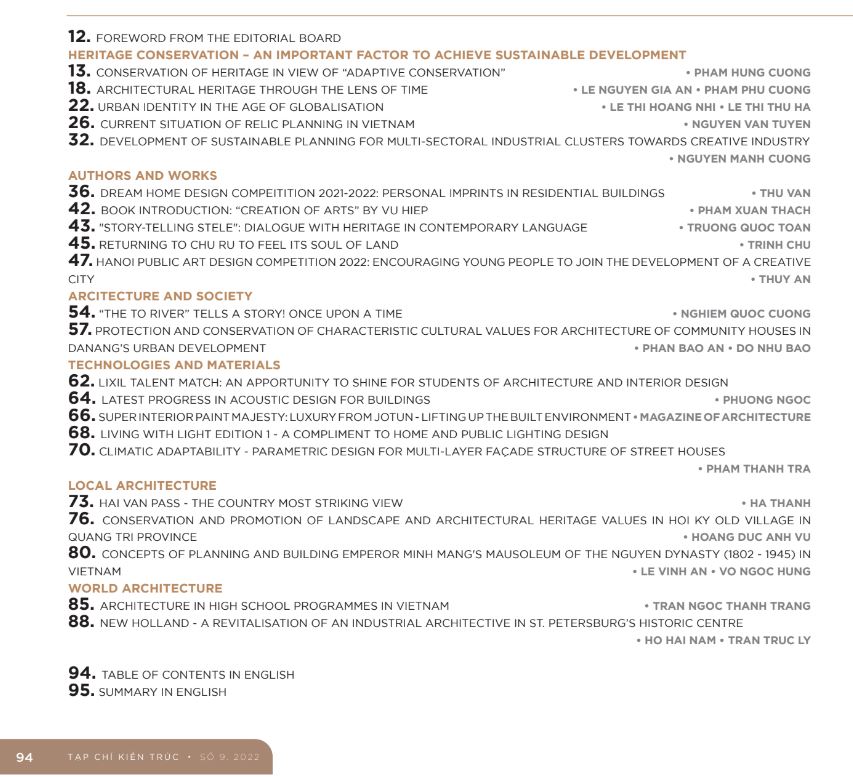
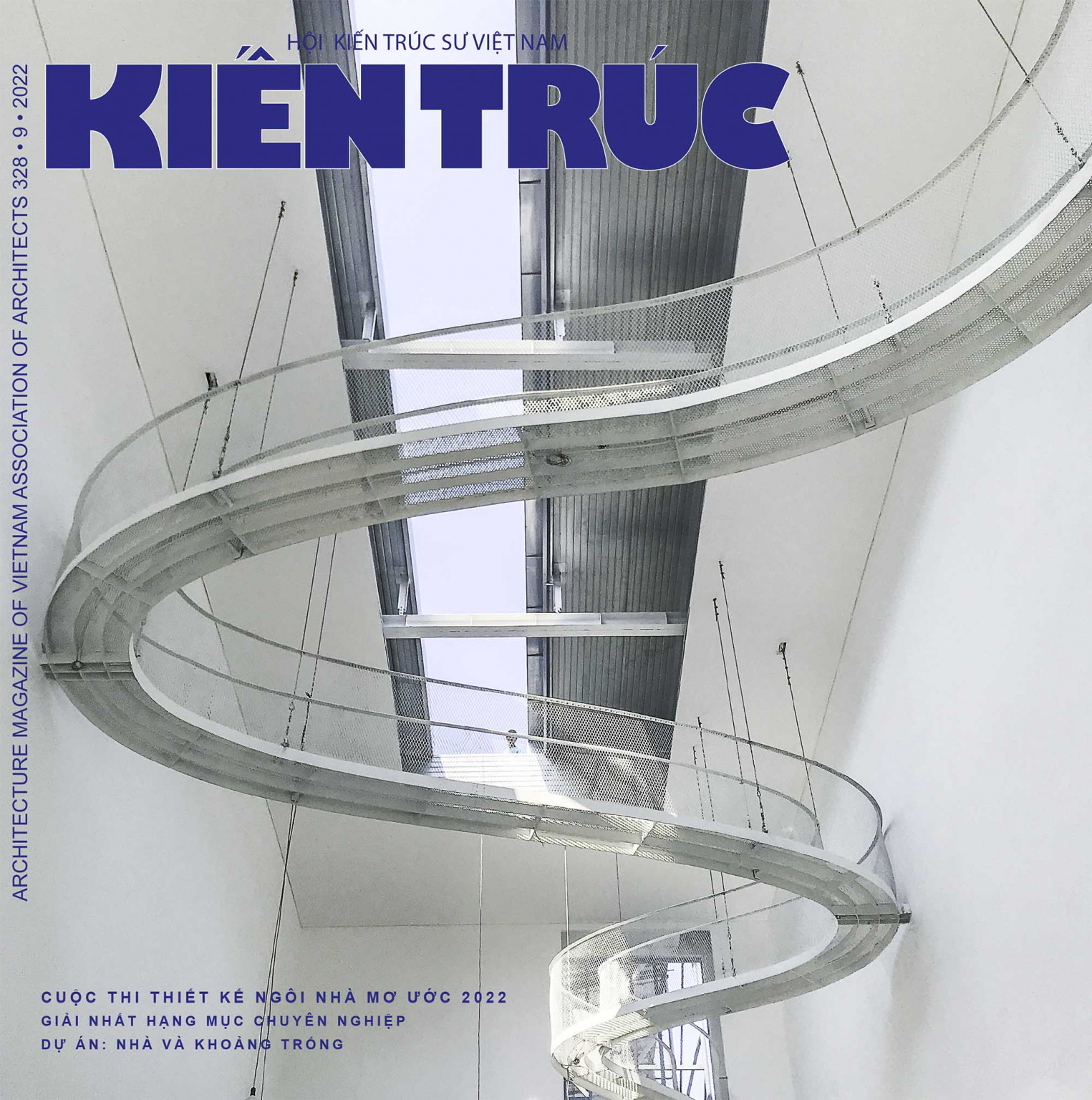
With this in mind, the Magazine of Architecture – September 2022 issue – will introduce to readers the theme “Conservation of heritage – A key factor for sustainable development” with articles focusing on recognising the role of cultural heritage (of which architectural heritage is an important part) and heritage conservation activities. This is the basis for well implementation of the conservation and promotion of the values of resources for the development, and at the same time, it can also help other areas in the development eco-system establish and strengthen the linkage as well as a good coordination in the implementation, and in the construction along with the socio-economic development of the country.
The World Architecture Section will end up this issue with an article sharing the experience of reviving an industrial architectural heritage in the historic centre of St. Petersburg. It is hoped that these lessons learnt will provide a new dynamo to contribute to the transformation of and the orientation for industrial buildings in Vietnamese city towards continuing and promoting potential urban cultural values which remain highly potential.
It is a great honour for us to sincerely introduce Architecture Magazine September 2022 to our readers!
Page: 13
CONSERVATION OF HERITAGE IN VIEW OF “ADAPTIVE CONSERVATION” • Pham Hung Cuong
In a number of previous articles, the author used the theory of “adaptive conservation” as an approach to conserve and promote the heritage values in traditional villages. This article further clarifies the principles, bases, positive and negative aspects, the possibility of developing this theory through examples in practice regarding the conservation of heritage values in traditional villages and communes in the Red River Delta and several cities today to solidify this theory.
Page: 18
ARCHITECTURAL HERITAGE THROUGH THE LENS OF TIME
• Le Nguyen Gia An • Pham Phu Cuong
Architectural heritage was built and has been existing in relation to time. Analyses around the topic “Time and Architecture” often attempt to deepen the close relationship between Space – Time – People. Time plays a role in influencing and guiding the way people create architecture. Human experience in architectural space evokes the sense of passing time. The author discusses the meaning of time in architectural heritage and it will clarify the values of architecture in light of this “hidden” dimension.
Page: 22
URBAN IDENTITY IN THE AGE OF GLOBALISATION
• Le Thi Hoang Nhi & Le Thi Thu Ha
It is apparent that the globalisation in economy is an inevitable development trend happening across the world. But the globalisation in culture is causing many problems about how to keep urban identity, especially in the rapid development of cities as what we see today. By 2050, more than two thirds of the world population will live in cities. Will the identity of cities be threatened by globalisation? How to create a city with identity in the age of globalisation?
Page: 32
DEVELOPMENT OF SUSTAINABLE PLANNING FOR MULTI-SECTORAL INDUSTRIAL CLUSTERS TOWARDS CREATIVE INDUSTRY
• Nguyen Manh Cuong
The concept of industrial clusters and the theory of zoning in industrial cluster planning have recently been in discussion and developed as an economic policy in order to enhance the efficiency of industrial development. Planning a multi-sectoral industrial cluster towards sustainable development is one of the important goals of global policy in general and for cities in Vietnam in particular.
Page: 42
BOOK INTRODUCTION: “CREATION OF ARTS” BY VU HIEP
• Pham Xuan Thach
With an interdisciplinary approach, Architect Vu Hiep seems to have come up with an answer of his own to the mind-boggling question for architects today: “What is identity in architecture of Vietnam?” Whether that answer is satisfied or not, readers will find their own conclusions after reading the book – Even if it cannot answer all the questions, certainly his concept of architectural identity will suggest at least some thoughts and creations in every reader, whether an architect or a non-professional who loves architecture.
Page: 45
RETURNING TO CHU RU TO FEEL ITS SOUL OF LAND
• Trinh Chu
Returning to the soul of the land to highlight the unique features of the land, Ka Don church has created new values, going beyond the limits of shape and function, where God’s nature and the church are mixed as one. According to Father Phero Tran Quoc Hung Long as the parish priest of Ka Don, “The return of the soul of land – the design of Ka Don church” after the church has been constructed with donations
and contributions of many professors, architects and engineers from both Germany and Vietnam, and tens of thousands of work hours of local residents. This design was awarded a Grand Prize of Religious
Architecture – Sacred Architecture at the fourth design competition organised in 2011 in Italy. In 2016, Ka Don church project continued to win a Second Prize of the 6th International Competition Holy
Architecture, again in Italy, organised by the Frate Sole Foundation around the world.
Page: 57
PROTECTION AND CONSERVATION OF CHARACTERISTIC CULTURAL VALUES FOR ARCHITECTURE OF COMMUNITY HOUSES IN DANANG’S URBAN DEVELOPMENT
• PHAN BAO AN • DO NHU BAO
We all know that the Vietnamese community house is considered a symbol of the local people’s culture and beliefs, with many cultural – architectural – artistic values that need to be conserved, renovated
and promoted. The article aims to (1) introduce some characteristics of decorative arts, landscape and community house architecture and (2) propose specific solutions to conserve and promote cultural and
architectural values of community house in Da Nang during the urban development of the city.
Page: 70
CLIMATIC ADAPTABILITY – PARAMETRIC DESIGN FOR MULTI- LAYER FAÇADE STRUCTURE OF STREET HOUSES
• PHAM THANH TRA
The content of this article explains a new concept – the street house multilayer- façade structure and the use of parametric method to adapt the built environment to climate-change conditions.
Page: 80
CONCEPTS OF PLANNING AND BUILDING EMPEROR MINH MANG’S MAUSOLEUM OF THE NGUYEN DYNASTY (1802 – 1945) IN VIETNAM
• LE VINH AN • VO NGOC HUNG
Emperor Minh Mang (1820 – 1841) was the second Emperor of the Nguyen Dynasty (1802 – 1945). His mausoleum was built around 1840 – 1843 in Hue as the past capital city of Vietnam, and it is considered the largest and most magnificent mausoleum complex in the golden years of the Nguyen Dynasty that
still remains today. Emperor Minh Mang’s mausoleum is one of the important components of Hue Monuments, recognised by UNESCO as a World Cultural Heritage in December 1993, with many values in history, culture, archaeology, architecture and art. This article is based on reliable historical documents and authentic database sources for the purpose of studying construction history, geographical Feng Shui concepts and planning as well as design techniques applied to mausoleum construction. Through this study, architectural concepts and design principles of the master plan have been identified, including: Principle of symmetry axis, translation and basic design concept. Then the constructor came up with an appropriate approach to find out the design principles of the planning and building of Emperor Minh Mang’s mausoleum.
Page: 88
NEW HOLLAND – A REVITALISATION OF AN INDUSTRIAL ARCHITECTIVE IN ST. PETERSBURG’S HISTORIC CENTRE
• HO HAI NAM • TRAN TRUC LY
New Holland is a complex of industrial architectural heritage for national defence with early Russian classical style located in the city of St. Petersburg (Russia). Covering an area of nearly 8 hectares in the heart of the city’s historic centre, New Holland has been able to open the door and become a favourite destination for community activities of the city’s residents in the past ten years. With more than 300 years of history and nearly half a century of redevelopment, New Holland is a vivid example of transforming urban industrial heritage into a public building complex with a variety of facilities.
Hopefully, this will be a lesson learnt as well as a motivation to contribute to the transformation of industrial architecture in Vietnam in continuing and promoting potential urban cultural values.
Xem thêm: https://www.tapchikientruc.com.vn/tap-chi-kien-truc/tap-chi-kien-truc-so-09-2022.html
© Tạp chí Kiến trúc