The International Union of Architects (UIA) has officially announced the results of the international competition “Architecture in the Post-Disaster Context”, organized within the framework of the UIA Work Programme on Natural and Human-Made Disasters, with professional support from the Moroccan Association of Architects. Notably, Vietnamese architects made a remarkable impression by winning the First Prize alongside several other important awards, reaffirming the country’s growing presence and professional capacity on the international architectural stage. Architecture Magazine is pleased to introduce the competition results to readers.
The competition invited young architects under the age of 40 from around the world to propose innovative and resilient architectural solutions responding to the aftermath of the 2023 earthquake in Morocco, with a focus on sustainability, community participation, and long-term recovery. Beyond disaster response, the competition sought to raise awareness of the complex relationship between natural and human-made crises, encouraging visionary proposals capable of healing, protecting, and regenerating affected communities.
Evaluation criteria included: analysis of the geographical and social context; the contribution of proposed strategies and design approaches; creativity and innovation appropriate to the local context; sustainable solutions (social, economic, and technical); social participation and cultural interaction; improvement of living conditions for affected communities; feasibility; and the originality of strategies, solutions, and design concepts.
The international jury panel included:
- Patrick Coulombel – President, representing UIA
- Salma Samar Damluji
- William Higgins
- Ghada Farouk Hassan
- Ayşen Ciravoğlu – representing UIA
- Ron Wickman (Alternate Juror)
Competition Results
First Prize – Trần Hữu Khoa (Vietnam)
The winning proposal stood out from the earliest rounds of evaluation thanks to its bold and innovative approach, capable of addressing both the broader community context and individual-scale needs, while demonstrating a profound understanding of the cultural and spatial identity of Douar Izloulen. Rooted in vernacular architecture and the environmental characteristics of the region, the project drew upon local craftsmanship, cultural landscapes, and active social participation to develop a coherent and compelling reconstruction strategy.


A major strength of the proposal lies in its integration of zoning and land-use strategies with a community-oriented housing approach that consistently prioritizes local materials, construction techniques, and skills. Reconstruction is framed not merely as physical rebuilding, but as a social process that strengthens community cohesion and supports future livelihoods, reflecting a sensitive and context-responsive urban vision.
The project further distinguished itself through the concept of “Magic Weaving”, combining low-tech seismic reinforcement systems with community-led construction processes, enabling rapid, cost-effective recovery deeply rooted in local culture. This approach is reinforced by a multi-scalar vision, ranging from immediate housing reinforcement to the creation of a communal village core and, ultimately, a resilient network of interconnected settlements.
Overall, the proposal presents an integrated, community-based, and transferable reconstruction model with strong potential for long-term resilience in remote disaster-affected regions.
Second Prize – Patrick Yakana Baliaba, Sidoine Baudrel Nde Keulek and Lizette Marlaine Tsafack Donfack (Cameroon)
The project “Izlloulen Resilient Village” was recognized for its deep understanding of the site context and its nuanced reinterpretation of local traditions through innovative and sustainable strategies. Based on comprehensive research into climate conditions, topography, environmental risks, and erosion patterns, the proposal combines rammed-earth construction techniques with sustainable energy and water management technologies.
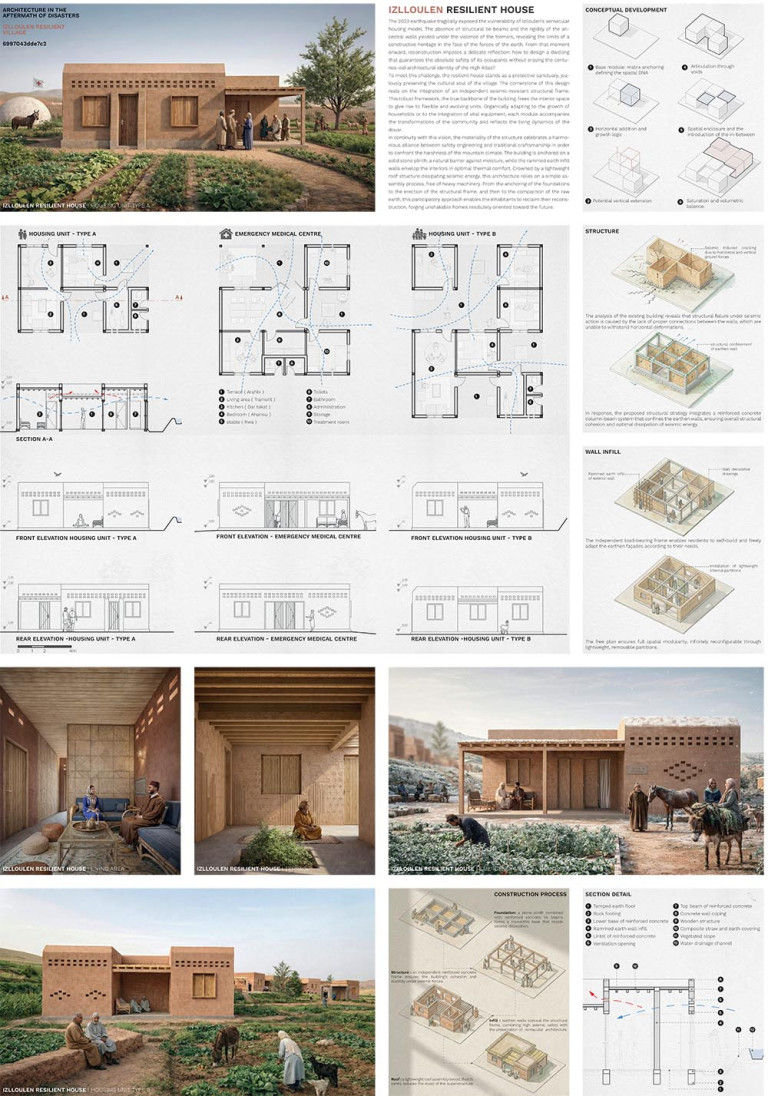
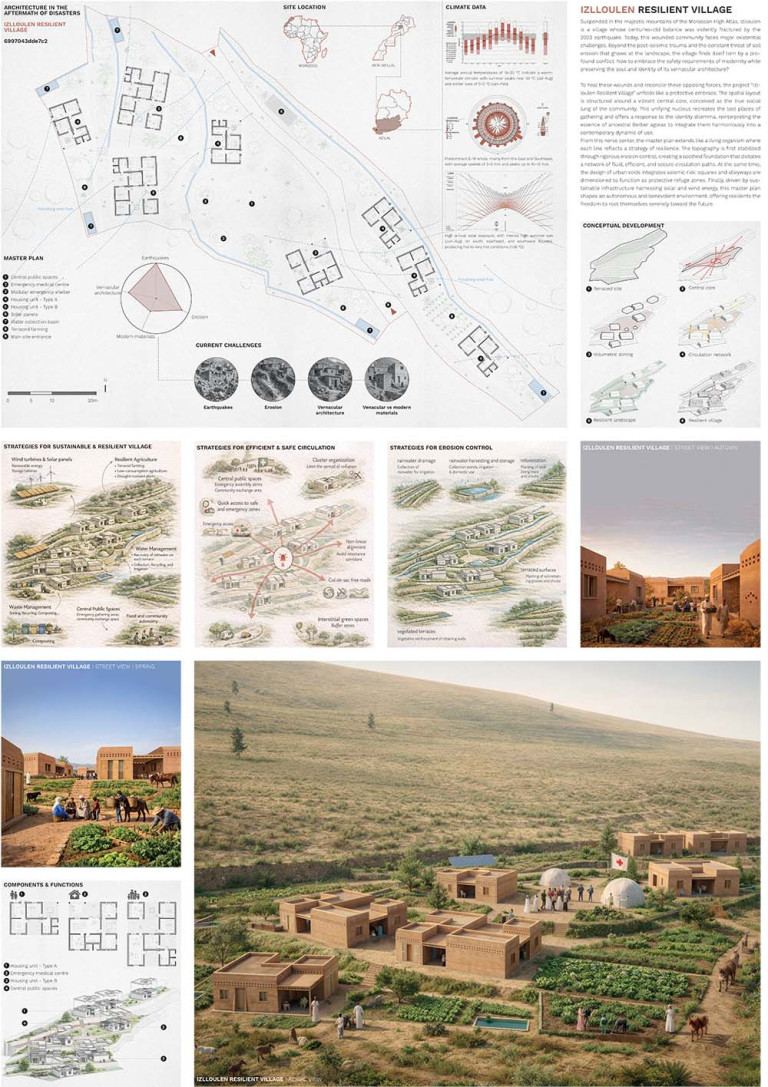
In doing so, the project preserves local cultural identity and craftsmanship while improving structural safety, environmental performance, and adaptability. It proposes a comprehensive and feasible vision for a resilient village model that simultaneously addresses territorial and social conditions through a community-centered approach.
The project aims to improve living conditions for affected residents, including people with disabilities, supported by clear environmental strategies and carefully considered earthquake-resistant solutions. Its strength lies in an integrated master plan that connects agricultural infrastructure, water management, and erosion control within a unified spatial structure adapted to climatic conditions.
The design organizes architectural forms around terraced farming systems and a social core serving residential clusters, while drawing inspiration from vernacular solutions incorporating urban voids to mitigate seismic risks.
Overall, the proposal offers a scalable, community-oriented reconstruction model capable of supporting long-term social, environmental, and economic recovery.
Third Prize – Oğuzhan Safa Yağcılar (Türkiye)
The project “SUR” demonstrated significant potential through its concept of regeneration, viewing disaster as an opportunity for renewal grounded in a deep understanding of the local context. The proposal introduces adaptive design solutions aimed at strengthening resilience and enabling communities to rebuild in ways that are both restorative and forward-looking.


Its strengths include integrating nature into the post-disaster recovery process, prioritizing repair over replacement, and establishing regenerative earth workshops to support local craftsmanship, livelihoods, and cultural identity.
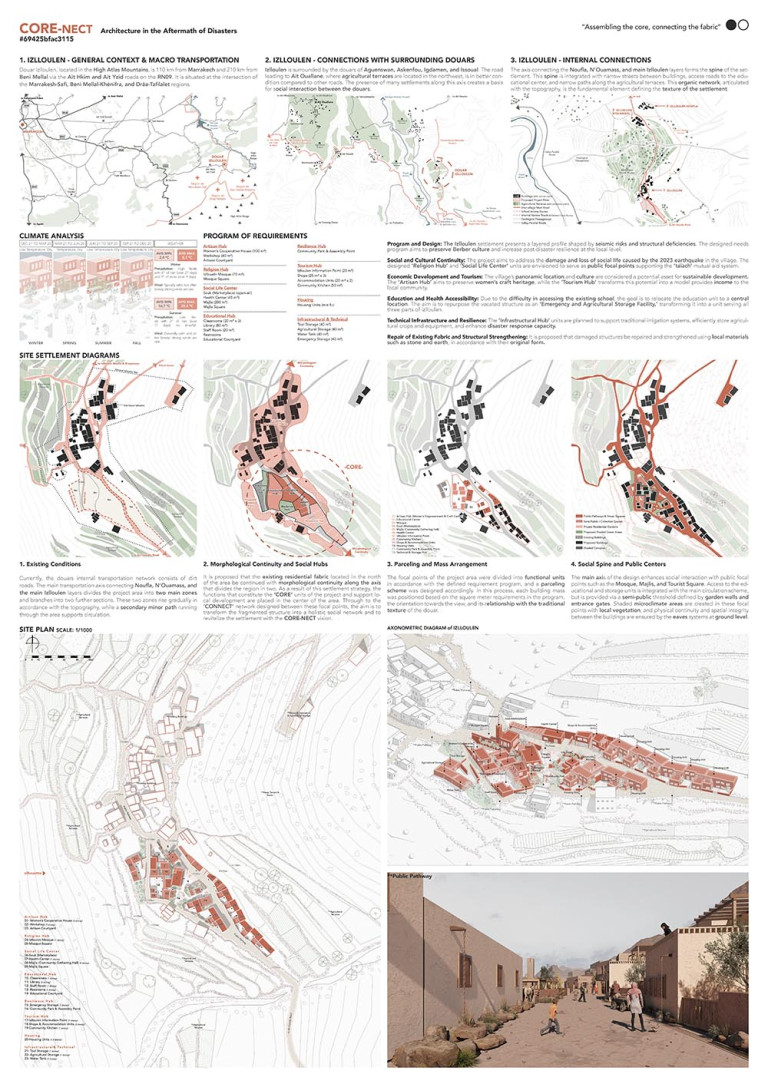
Fourth Prize – Asude Gündoğdu and Sefa Cengiz Okan (Türkiye)
The project “CORE-NECT” enhances post-disaster resilience through a network of public nodes organized around a central “core,” including spaces such as Religious and Social Life Centers that support the traditional spirit of touiza – collective mutual aid. The proposal effectively combines large-scale planning with a clear community-oriented approach.

Fifth Prize – Uğur Özkalaycı, Müge Uysal and Şevval Tatar (Türkiye)
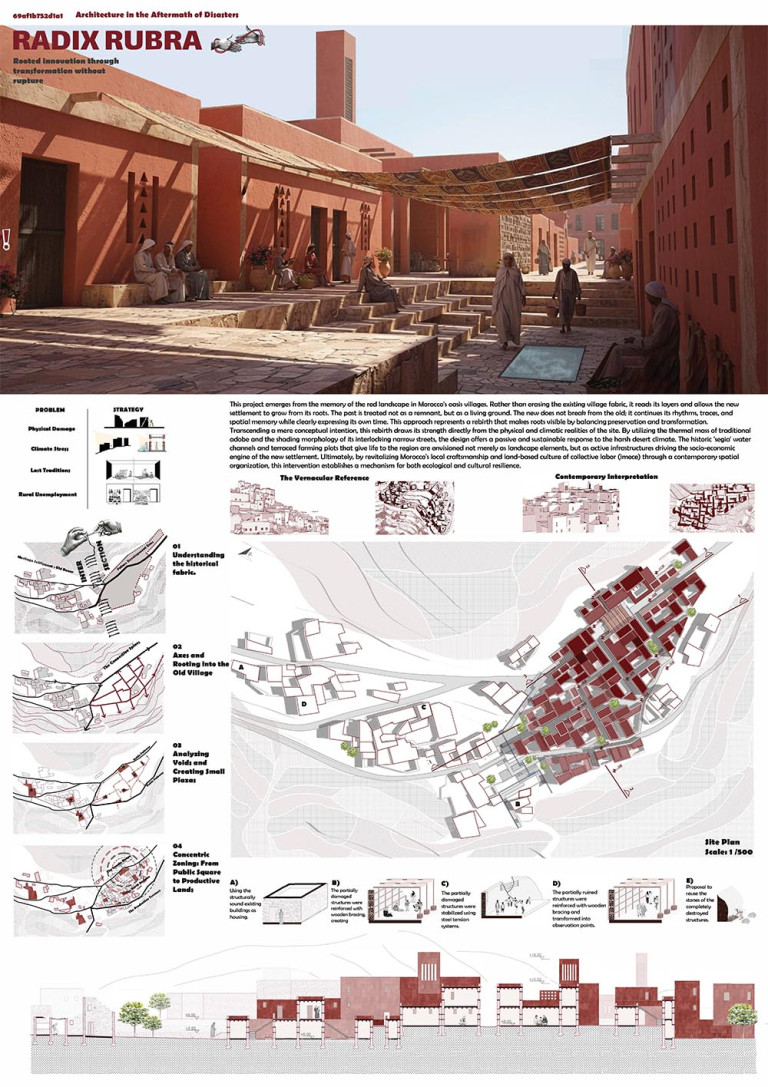
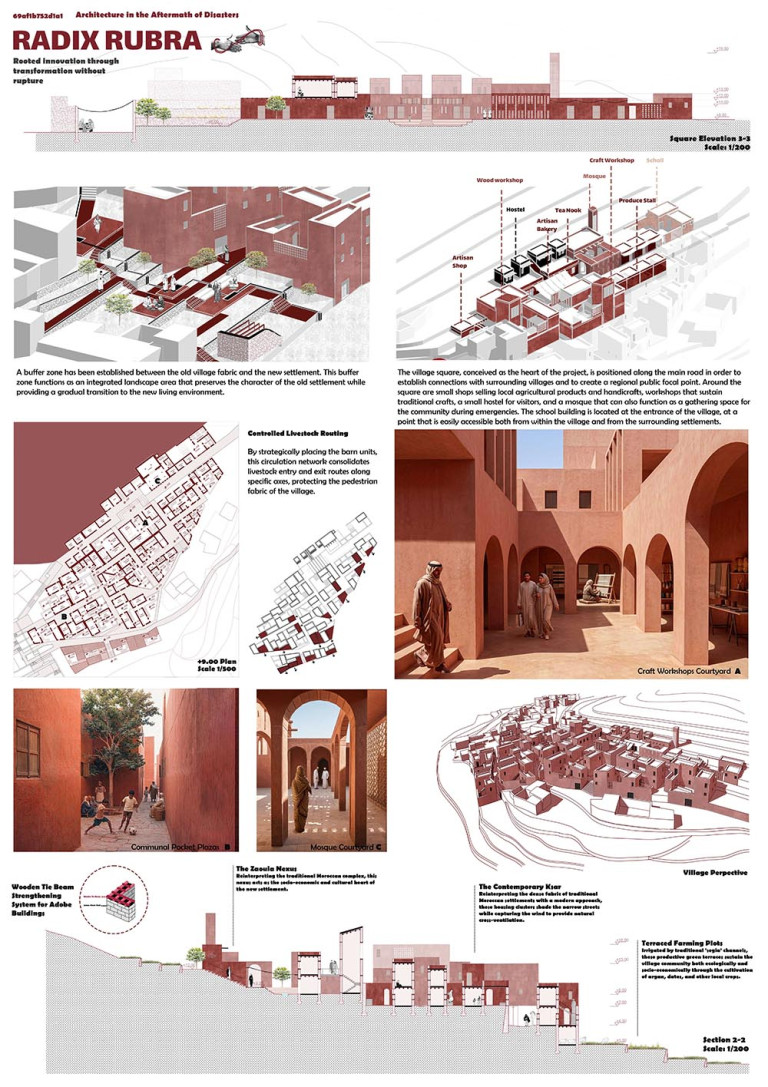
The project “Radix Rubra” was highly regarded for its emphasis on reviving local craftsmanship and collective participation in landscape-based reconstruction, addressing both ecological and cultural resilience within an urban-rural context.
Consolation prizes:
+ Mahdi Bayat & Zahra Lak (Iran)


+ Esraa Elazab & Ahmed Hassan (Egypt)


+ Agustin Camicha, Alejandro Rodriguez Silva and Fatima Gomez Rodriguez (Argentina/Spain)


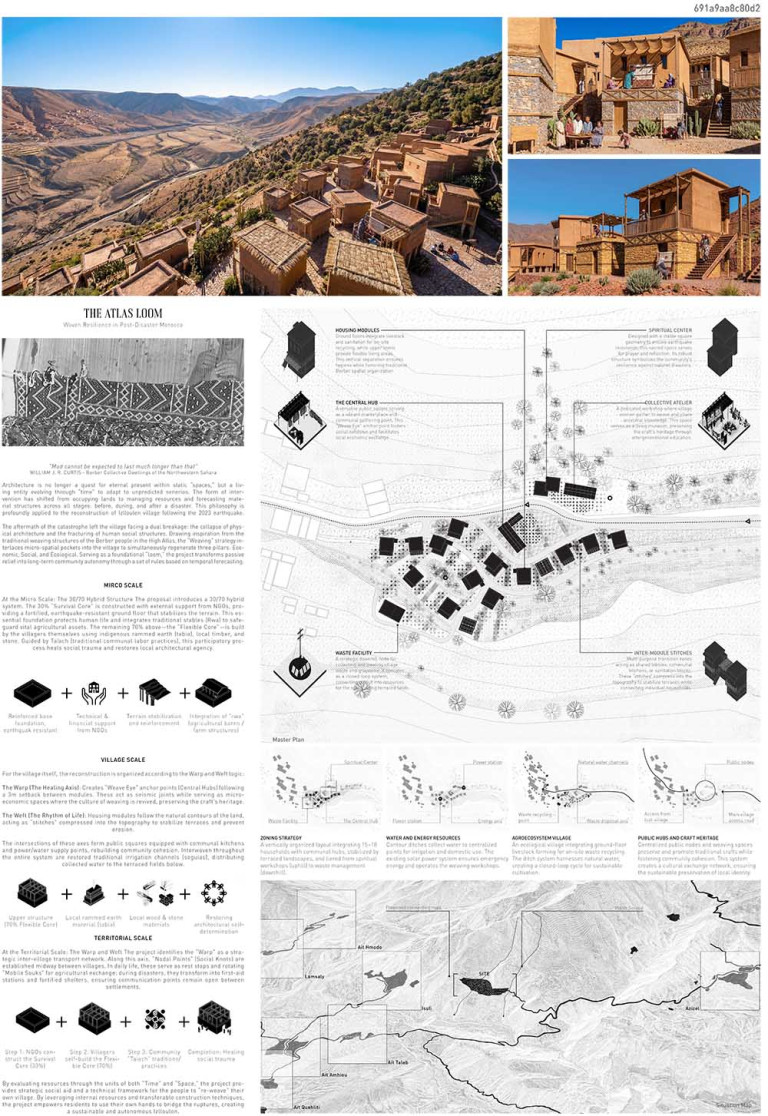
+ Đặng Lê Như Ngọc & Trần Khoa Thanh (Vietnam)

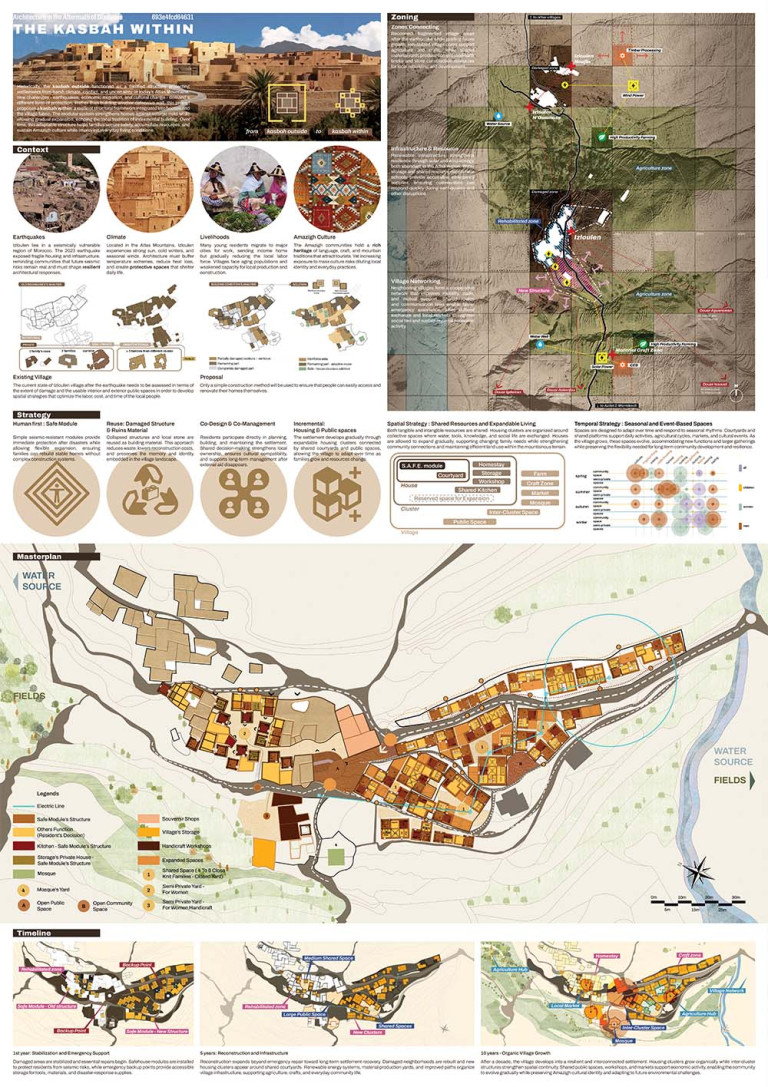
+ Đào Duy Tùng & Dương Ngọc Huy và Phạm Nguyễn Tùng Chi (Vietnam)

Thuy An (Translated and compiled from UIA sources)
© Vietnam Architecture Magazine