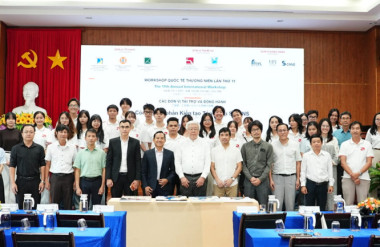
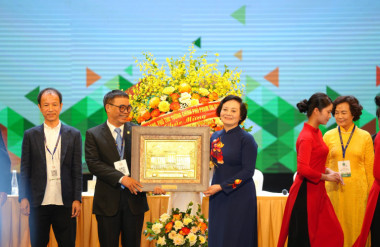
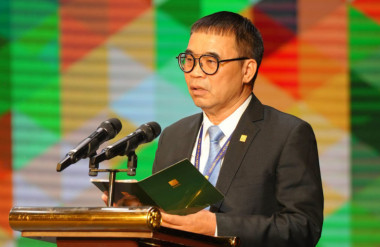
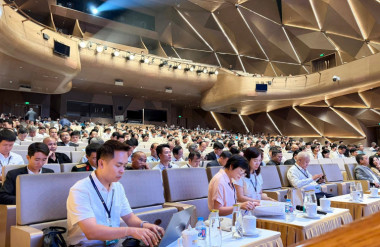
On the morning of Sunday, 11 February 2026, at the Octagonal Pavilion by Hoàn Kiếm Lake, the panel discussion “From an Annual Festival to an Urban Creative Ecosystem” took place as part of the “Creative Gathering” series – an ongoing journey toward the Hanoi Festival of Creative Design 2026.
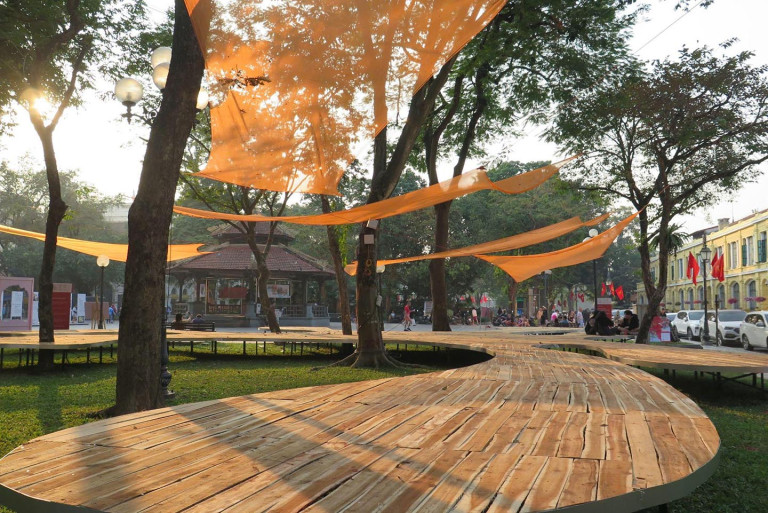
Photo: Nguyễn Trâm.
Held within the Lý Thái Tổ Garden, where specially designed architectural pavilions host exhibitions and community activities, the discussion unfolded as an open and dynamic dialogue – reflecting the very spirit of an emerging urban creative ecosystem.
The session was structured around three key themes: clarifying the concept and real-world practices of the creative economy and urban creative ecosystems; identifying needs, expectations, and bottlenecks among stakeholders; and proposing mechanisms to ensure sustainable operation of the ecosystem from 2026 onward. The panel brought together a diverse group of speakers – from government agencies, international organisations, research institutes, and educational institutions to businesses, artists, and social organisations – collectively representing the building blocks of an urban creative ecosystem.
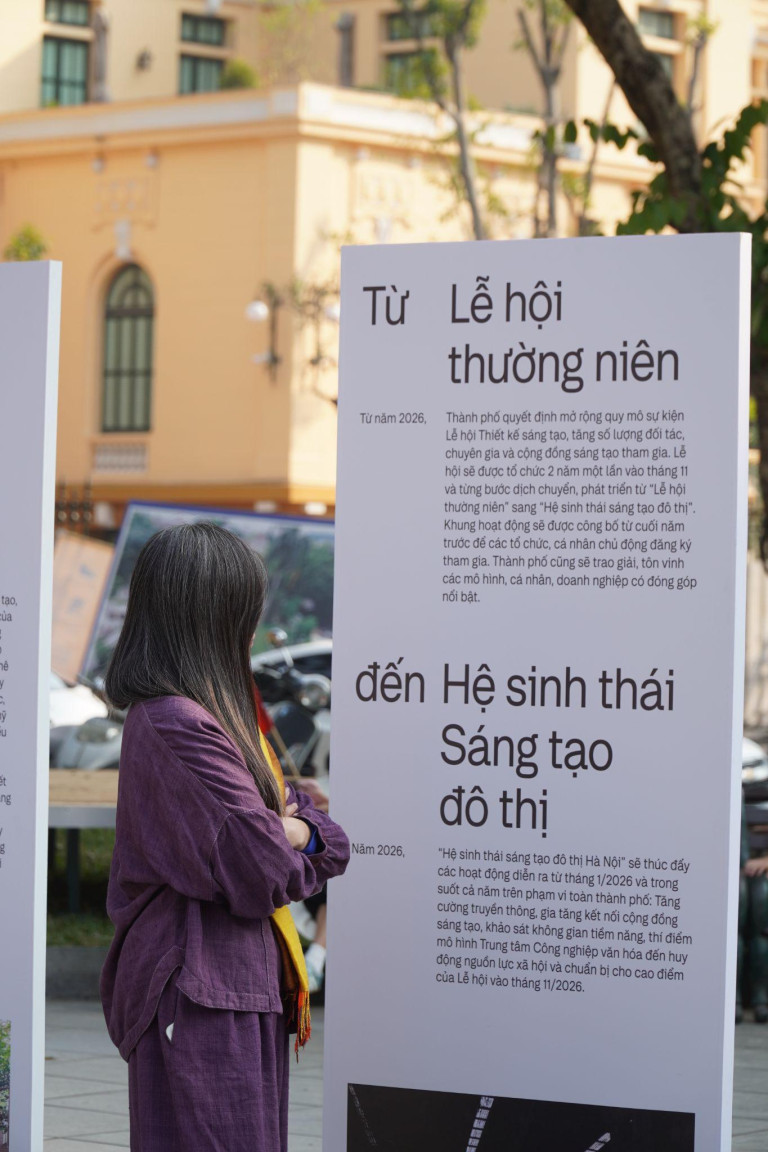
In the first segment, speakers focused on establishing a shared conceptual framework. Representing the Hanoi Department of Culture and Sports, Ms. Bùi Thị Hương Thủy emphasised a community-centered and sustainability-driven approach, noting that long-term collaboration among stakeholders is essential for the festival to evolve beyond a one-off event. From an academic perspective, Dr. Nguyễn Thị Thu Hà (Vietnam National Institute of Culture, Arts, Sports and Tourism) described the creative ecosystem as a symbiotic structure, where actors, institutions, and policies interact organically to generate economic, social, and cultural value, as well as human development.
This perspective led to a key insight: Hanoi does not lack creativity, it lacks mechanisms to recognise and connect existing resources. Architect Đoàn Kỳ Thanh highlighted the spatial dimension, stressing the importance of physical infrastructure and the “emergence effect” that occurs when creative industries coexist within shared spaces. According to him, an ecosystem can only function effectively when stable creative spaces enable collaboration and synergy. From UNESCO’s standpoint, Ms. Phạm Thị Thanh Hường placed Hanoi within a global context, reaffirming culture as the fourth pillar of sustainable development and commending the city’s use of festivals as a tool to mobilise cultural and human resources for urban regeneration.
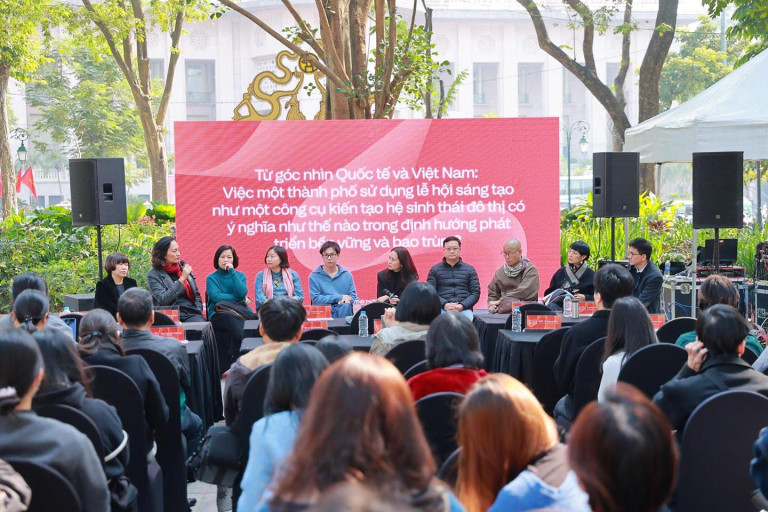
Photo provided by the organizers of the Hanoi Creative Design Festival 2026.
The second segment shifted to practice, where creative practitioners shared firsthand experiences, needs, and challenges in shaping the ecosystem. Designer Nguyễn Uyển Ngọc, Founder and Creative Director of Hai&Ikigai Design Studio, highlighted the importance of access for young creatives and raised the question of how they can “enter” the ecosystem. For the younger generation, she noted, participation alone is not enough – what matters is the ability to create meaningful, long-term social and cultural impact beyond temporary exhibitions.
Curator and artist Nguyễn Thế Sơn pointed out the shortage of stable physical spaces in Hanoi, which has led to what he described as a form of “nomadic creativity” among artists. Echoing this, Mr. Lê Quang Bình, Director of ECUE and Coordinator of the “For a Livable Hanoi” Network, underscored that physical infrastructure is a fundamental condition for building a sustainable creative ecosystem. Across different perspectives, a shared conclusion emerged: without strong institutional and physical foundations, the ecosystem cannot generate sustainable livelihoods.
In the final discussion, a thought-provoking question: “If you could contribute just one initiative to the Festival from 2026 onward, what would it be?”, prompted participants to define their roles within the ecosystem and articulate long-term visions. Proposed solutions converged around three key pillars: improving policy frameworks and enabling mechanisms; investing in creative infrastructure as essential urban infrastructure; and strengthening connections between creativity, education, business, and community.
Dr. Lư Thị Thanh Lê (Vietnam National University, Hanoi) emphasised that the Festival should be viewed as an “open laboratory,” where creative models, from production and distribution to exhibition, feedback, and critique, can be tested and refined.
Audience discussions further explored a central question of any creative ecosystem: who gets to participate, how, and under what conditions. Topics such as access for students, the role of markets and sidewalks as community spaces, and urban livelihoods underscored that a creative ecosystem extends beyond art and design, it is deeply embedded in everyday life and civic participation.
Closing the session, Ms. Bùi Thanh Hương, representing the co-organising body, reaffirmed that the success of the Festival ultimately depends on the community. She called for public engagement in three key areas: mapping potential spaces, contributing ideas through open calls and the Creative Gathering programme, and participating as mentors or curators to nurture emerging talents. With over 80 proposals already submitted, the Festival is envisioned as an incubator for creative ideas that can evolve into viable cultural industry outputs.
From the Hanoi Department of Culture and Sports, Ms. Bùi Thị Hương Thủy also noted that the city has issued Plan 333 – the overarching framework for the Hanoi Festival of Creative Design 2026 – placing sustainable urban regeneration and the resolution of Hanoi’s structural challenges at its core. In this context, the Festival is positioned not merely as a cultural event, but as a policy-testing platform to receive, evaluate, and implement innovative ideas for urban transformation.

The discussion ultimately framed “ecosystem connectivity” as a structure for collective action – linking institutions, policies, infrastructure, education, businesses, artists, and communities. When each stakeholder fulfils its role and is effectively connected to others, the Hanoi Festival of Creative Design can evolve into a long-term operational platform for a vibrant urban creative ecosystem.
© Vietnam Architecture Magazine