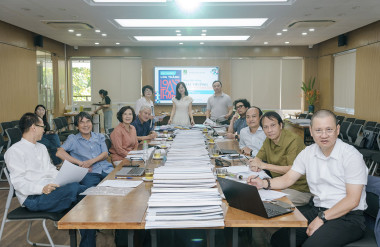
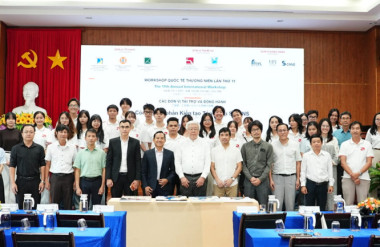
On November 26, 2025, at the headquarters located at 31A Trang Thi Street (Cua Nam Ward, Hanoi), the Hanoi Architects Association, in coordination with the Hanoi Department of Planning and Architecture, organized a professional forum focusing on two key topics: Professional Practice Licenses in Planning and Architecture: Challenges and Proposals from Architects and Solutions for Preventing Basement Flooding in Urban Buildings.
The event was held as part of the Association’s 2025 work program and drew participation from representatives of the Hanoi Department of Planning and Architecture, the Standing Committee and Executive Committee of the Association, a large number of members, and invited professional experts.
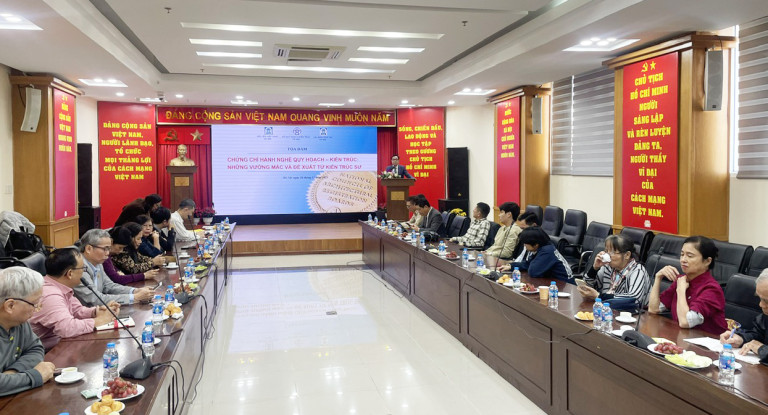
In the first discussion session, participants focused on clarifying difficulties and shortcomings in the issuance, renewal, and recognition of professional practice licenses (PPLs) for architects and planning professionals. Many opinions noted that current procedures remain cumbersome, with certain documents duplicated or insufficiently integrated into digital systems, requiring architects to resubmit materials that could otherwise be retrieved electronically. Inconsistencies in the interpretation and application of regulations across localities were also identified as obstacles to professional planning, participation in bidding processes, and assuming project leadership roles.
One issue that drew significant attention was the requirement to prove professional experience. According to delegates, many architects who are directly involved in design, technical management, or key project roles are not legally named in project documentation, making it difficult for them to complete experience dossiers in compliance with formal requirements. This creates a gap between actual professional competence and administrative evidence, resulting in evaluations that do not fully reflect practitioners’ true capabilities.
In addition, the current PPL system is divided into multiple narrowly defined categories-such as design, appraisal, technical infrastructure, and master planning. Delegates argued that this fragmentation increases costs and administrative burdens, while failing to reflect the interdisciplinary and highly integrated nature of planning and architectural practice in today’s urban development context. The assessment process was also criticized for placing excessive emphasis on memorizing regulations, with insufficient focus on practical exercises, professional scenarios, or real project-based evaluations.
At the forum, Architect Tran Viet Thang from the Hanoi Department of Planning and Architecture stated that the current licensing process is being implemented in accordance with legal regulations and is not as complex as often perceived. He emphasized that the Department actively supports practitioners in preparing documentation and navigating procedures, while regularly consulting with relevant authorities to refine processes and develop legal frameworks aligned with professional practice and societal needs. The Department expressed its willingness to continue receiving feedback from architects to ensure that reform efforts are both effective and grounded in reality.
The second discussion session addressed basement flooding in urban buildings-an increasingly serious challenge amid extreme rainfall events and overloaded drainage systems. The Architects’ Chapter of Van Phu – Invest Real Estate Development Joint Stock Company presented an automatic basement floodgate system that has been implemented in several Van Phu – Invest projects. According to the presenter, the system is capable of protecting buildings and residents’ assets during sudden flooding events and features clear operational and maintenance procedures suitable for residential complexes, office buildings, and commercial centers.
Beyond floodgate solutions, several delegates also introduced and recommended the application of permeable ground systems to reduce surface runoff, thereby supporting urban drainage networks-particularly in high-density built environments. During the open discussion, many architects acknowledged the potential of the proposed solutions, while emphasizing the necessity of integrated approaches combining building-level measures with broader urban infrastructure solutions. Delegates further suggested the early development of technical standards and guidelines for basement design under rapidly changing climate conditions and increasingly frequent extreme weather events.
Concluding the forum, Dr. Architect Ta Nam Chien, Vice President of the Hanoi Architects Association, highly valued the practical contributions from participants and invited experts. He stressed the need to further reform the professional licensing process toward greater simplicity, transparency, and nationwide consistency. Evaluation criteria, he noted, should more accurately reflect architects’ actual roles and responsibilities in projects, rather than relying solely on formal documentation. Additionally, the licensing system should be streamlined to align with integrated professional practice trends and the rapid advancement of digital technologies-particularly AI in architectural design.
Regarding basement flood prevention, the Association will continue to consolidate proposals and recommend further research and pilot applications of solutions such as automatic floodgates and permeable ground systems, with the aim of gradually standardizing and implementing them in practice.
The Hanoi Architects Association announced that it will compile all feedback and recommendations to submit to the Hanoi People’s Committee, the Department of Planning and Architecture, and relevant regulatory bodies, contributing to the improvement of professional practice mechanisms and the overall quality of planning and architectural work in the capital. The forum concluded at 5:00 PM in a constructive, open, and professional atmosphere.
© Vietnam Architecture Magazine