On March 7, 2025, the Vietnam Association of Architects held the first meeting to launch the green-sustainable social housing design competition under the direction of the Prime Minister. The Architecture Magazine was assigned to be the focal point for organizing the competition, coordinating with relevant units and experts to ensure the quality and effectiveness of the competition.

Previously, on the afternoon of March 6, 2025, Prime Minister Pham Minh Chinh chaired the National Online Conference on removing difficulties and obstacles to promote social housing and assigned the Vietnam Association of Architects to launch a national social housing architecture design competition, finding typical designs that can be applied in urban areas, areas with a large number of workers, etc., completing this work from now until April 30 in the spirit of saving time, intelligence and determination. The Ministry of Construction designed models and modules to shorten construction time; assign large enterprises to develop social housing; develop the housing development industry systematically; and promote the creativity of people and enterprises.
Social Housing – Urgent Solution for the Real Estate Market
Developing social housing is not only an urgent task to meet social security needs but also an important driving force to promote the healthy development of the real estate market. The National Housing Development Strategy to 2020, with a vision to 2030, aims to build 100 million square meters of floor space each year, of which at least 20% of the floor space is for low-income people.
However, according to data from the Ministry of Construction, from 2021 to present, the whole country has 655 social housing projects implemented with a total scale of 593,428 units, but only 103 projects have been completed with more than 66,755 apartments. This number is still very modest compared to actual demand.
With these difficulties, finding optimal social housing design solutions that meet practical needs, save costs and speed up construction progress is an urgent requirement.
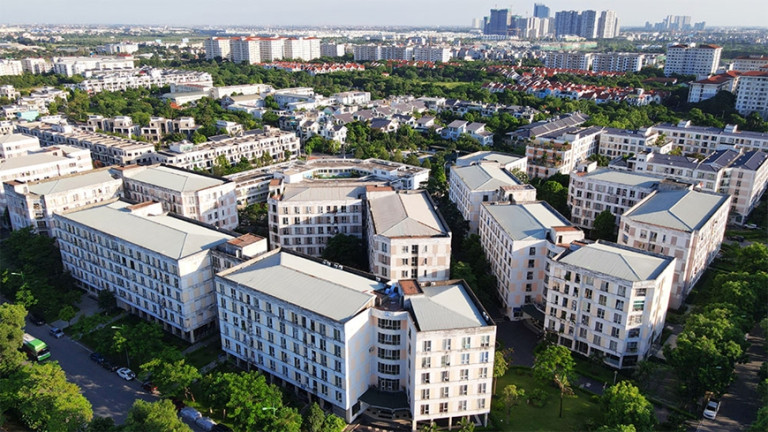
Design Competition – Solution for Social Housing
As a professional socio-political organization assigned by the Party and State, the Vietnam Association of Architects has always clearly defined its role and responsibility in the cause of building and developing modern Vietnamese architecture with its own identity under the leadership of the Party; participating in the development of urban and rural architectural planning, including the housing sector in general and social housing in particular.
Currently, the number of social housing projects put into use is still very lacking. The cost is high, not suitable for the actual income of low-income people in large cities; the speed of implementing the target of 1 million apartments by 2030 is still very slow, and there is a possibility that it will not be completed. There are many reasons, but according to the Vietnam Association of Architects, we are lacking typical designs (models) for social housing that are suitable for regional and local cultures.
To contribute to solving difficulties and obstacles, promoting the development of social housing, the Vietnam Association of Architects proposes to organize a competition for social housing architectural plans suitable for regions, in order to have highly applicable designs, which will save costs and especially shorten construction time.
The competition will gather domestic and international architects, consultants, and project developers with 3 main goals:
- Seek prominent designs, widely applicable, capable of being built in large cities and compact urban areas associated with public transport (TOD)
- Encourage social housing designs with technical and technological solutions to ensure the ability to assemble for fast, economical construction, reduce apartment costs to ensure sustainability and allowable amenities.
- Create conditions (through preferential policy mechanisms) for large domestic enterprises to participate in developing the assembly manufacturing industry and building social housing.
- The ideas, models, and samples of Social Housing that participants contribute to the competition not only devote to building beautiful, comfortable living spaces but are also optimal, smart in design, and sustainable Social Housing Solutions in the future.
Expert opinions on the Green and Sustainable Social Housing Design Competition

Sharing at the meeting, Dr. Architect Phan Dang Son – Chairman of the Vietnam Association of Architects emphasized, “The competition is organized to stimulate creativity, critical thinking and the spirit of cooperation among architects, designers, investors and experts in the industry. Excellent designs will help develop sustainable, cost-effective social housing that can be replicated nationwide.”
Accordingly, the competition is not only for architects but also extended to four main groups: Architects, project developers, construction contractors and material manufacturers. This combination aims to ensure that the designs are not only creative in architecture but also highly feasible in practice.

Architect. Dang Kim Khoi – Vice President of the Vietnam Association of Architects said that the plans participating in the competition need to focus on ensuring the following requirements: (1) Optimizing construction costs, (2) Ensuring industrialization, (3) Having fast construction time, (4) Applying green solutions and passive design, towards sustainable development.
In addition, Architect Nguyen Van Hai – President of the Hanoi Association of Architects said that social housing models need to meet the standards of independence – self-contained, ensuring the living conditions of people in the contemporary context. At the same time, the design of social housing needs to meet the standards of medium-sized commercial housing, with appropriate area and scale.

From the perspective of materials and techniques, Dr. Tran Ba Viet – Vice President of the Vietnam Concrete Association emphasized that the design of social housing needs to ensure 3 factors at the same time: industrialization, typicalization and modularization. This helps to optimize costs and time during construction. In particular, the modularization content should focus on panels rather than modularizing the space to avoid difficulties in the transportation and assembly process.
From a practical perspective, Architect Hoang Thuc Hao – Vice President of the Vietnam Association of Architects proposed a plan to mobilize the participation of investors and consultants with existing works – practical projects to edit and complete from practical experience, in order to shorten the research and implementation time.

In addition, Architect Vu Van Dung – Deputy Director of the Department of Construction and Barracks Management, Chairman of the Association of Architects of the Ministry of Public Security, proposed to develop an open design topic. Accordingly, investors can rely on the core design of the architect to customize and be flexible in choosing material solutions and architectural forms according to actual needs. This helps increase the applicability and implementation efficiency for social housing projects on a large scale.
According to experts, one of the important criteria of the competition is to propose solutions for industrialization, reducing costs while still ensuring quality of life. Social housing must meet the living needs of the subjects in a harmonious, convenient way, meeting basic standards equivalent to ordinary commercial housing. In particular, the design must be suitable for the climate and soil conditions of each region and have a breakthrough in shortening the design and construction time compared to the present. The competition plans to focus on two types of social housing: for sale and for rent. The apartment quota will be based on the actual needs of the target groups and have flexible proposals to ensure high practicality.
The types of mobile modules in the combination of the ground plans of many regions are the key factors in this competition. Social housing is not reserved for one group of residents but must meet the needs of a variety of subjects, all ethnic groups can live in that space. The local cultural identity will be reflected mainly through the homeowner’s layout, while the overall design must ensure flexibility and replicability.
With the attention from the Government, the participation of experts, designers, investors and businesses, the social housing design competition is expected to bring breakthrough solutions, creating a premise for the sustainable development of social housing in Vietnam in the coming period. Information will be updated by the Architecture Magazine on the website www.tapchikientruc.com.vn
An Du
© Vietnam Architecture Magazine