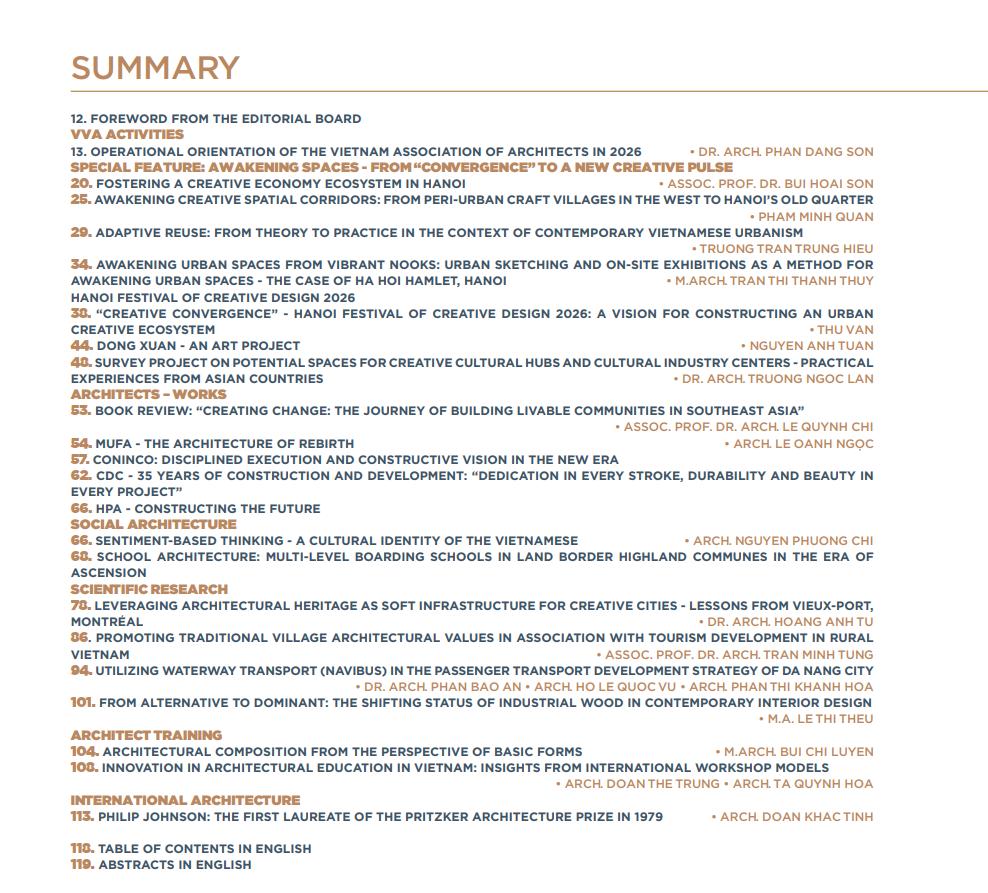
Page: 12
Foreword from the editorial board
Dear Readers,
You are holding in your hands the first issue of Architecture Magazine for 2026, filled with nurtured ideas, green shoots taking shape, and, of course, opportunities being connected.
In this January issue, we join a special feature: “Awakening Spaces – Reviving Urban Heritage”. This year, the theme “Awakening Spaces” returns with new nuances, aiming to activate creativity and create new values upon old foundations. Here, when a heritage structure interacts with contemporary design thinking within the flow of the creative economy, it contributes to forming a vibrant ecosystem, where heritage becomes a potential resource and culture becomes a driver for sustainable growth.
This is also the spirit of the Hanoi Festival of Creative Design, directed by the Hanoi People’s Committee and the Vietnam Association of Architects, and organized by the Hanoi Department of Culture and Information in coordination with Architecture Magazine, accompanied by UNESCO and other key partners. In early January 2026, the “Creative Convergence” officially launched the journey toward the Hanoi Festival of Creative Design 2026 with a roadmap to build an open creative ecosystem and a strong policy: “Creativity must become the source – Innovation must become the operational method – The link between the State, businesses, the creative community, and society must become the driving force for development!”
In that spirit, in this special issue, the presence of architects, designers, and research experts will join hands to awaken potential spaces, breathing new life into them, creating new values, and contributing to transforming heritage into vital resources of the creative economy… So that heritage is not merely an architectural work but becomes a creative space, an inspiring destination for the future.
Welcoming the new Spring of the Horse (Binh Ngo), the Editorial Board wishes our readers luck and prosperity – And let us connect to aim for creative rhythms in the new era!
Respectfully introducing Architecture Magazine Issue 01/2026!
Architecture Magazine
Page: 13
Operational orientation of the Vietnam Association of Architects in 2026
• Dr. Arch. Phan Dang Son
2026 is a year of significant events, particularly the 14th National Party Congress, featuring important historical guidelines and policies to lead our country’s strong and sustainable development in the new era. Therefore, the 11th Congress of the Vietnam Association of Architects must be thoroughly imbued with the Resolution of the 14th Party Congress, translating it into objectives and operational programs for the Congress and the Association. More than ever, the Vietnam Association of Architects needs to be proactive and creative, implementing digital transformation linked with the development of science, technology, and arts and culture – This continues to be identified as a key focus with a new spirit and momentum. As the Association’s top political task in 2026, preparations for the Congress-from personnel and drafting documents to organizational facilities-must receive the utmost attention from the Central Executive Committee, the Standing Committee, and the Permanent Committee of the 10th Term, unlocking high-performance activities for the Vietnam Association of Architects in the new term.
Page: 20
Fostering a Creative Economy Ecosystem in Hanoi
• Assoc. Prof. Dr. Bui Hoai Son
Standing Member, Committee for Culture and Education of the National Assembly
Recalling General Secretary To Lam’s words, he emphasized that “in the digital age, creativity is the main artery, innovation is the method, and connection is the driving force” – This message is also a reminder that: There is no creativity without aspiration! No innovation without commitment! And no development without the joint effort of the whole society. With strategic vision, innovative courage, and determination to act, Hanoi can fully rise to become one of the dynamic creative hubs of the region, while preserving the identity of a Capital that is “Cultured – Civilized – Modern – Creative and Livable”. Then, the creative economy will not only be a development model but also the path for Hanoi to affirm its position, spread Vietnamese cultural values to the world, and contribute to realizing the aspiration for a prosperous and happy country in the new era.
Page: 25
Awakening Creative Spatial Corridors
From Peri-urban Craft Villages in the West to Hanoi’s Old Quarter
• Pham Minh Quan
Hanoi does not develop as a closed entity. Thang Long, Ke Cho was formed from a network of surrounding villages and craft villages, especially the peri-urban area in the West, the ancient land of Doai. Craft villages provided products, techniques, and aesthetics to the imperial capital, while creating a close link between rural production and urban consumption. Hanoi’s Old Quarter, with its characteristic “Hang” streets system, is the “representative” space of those craft villages. Placed in the context of rapid urbanization in recent decades, this link has gradually been broken, causing the cultural flow that once operated flexibly to become disjointed and less visible in contemporary urban life.
Page: 29
Adaptive Reuse: From Theory to Practice in the Context of Contemporary Vietnamese Urbanism
• Truong Tran Trung Hieu
In major cities in Vietnam, abandoned sites such as old factories, inactive markets, old residential areas, and river flats are often seen as signs of resource waste. This poses a paradox: While urban residents lack public spaces for relaxation, interaction, and bonding, many infrastructure items are gradually degrading. This article discusses the adaptive reuse approach as a proposal for the above problem – By examining this approach from aesthetic, economic, and social perspectives, the article contrasts it with the current situation in Vietnam and proposes several development directions for the future.
Page: 34
Awakening urban spaces from vibrant nooks
Urban sketching and on-site exhibitions as a method of awakening urban spaces – The case of Ha Hoi Hamlet, Hanoi
• M.Arch. Tran Thi Thanh Thuy
Lecturer, Faculty of Interior Design, Hanoi Architectural University – Leader of Urban Sketchers Hanoi
In the context of rapidly changing Vietnamese urban areas, “awakening urban space” is often understood as major interventions in planning, architecture, or investment. However, reality shows that many urban spaces are not “sleeping” but are living, operating, and accumulating value every day in the daily life of the residential community. Through the practice of urban sketching and organizing on-site exhibitions in Ha Hoi Hamlet (Hanoi), the article shares a different approach: awakening space by slowing down, by on-site observation, and by dialogue between art – space – community. Urban sketching, in this case, is not just an artistic activity but becomes a soft tool to help identify, connect, and reveal the values of living urban heritage from the very small corners persistently existing within the heart of the city.
Page: 44
Dong Xuan – An Art Project
• Nguyen Anh Tuan
Not merely a symbol of bustling trade, Dong Xuan Market is viewed as a cultural and historical “ecosystem” facing the immense challenges of e-commerce and modern urbanism. The article introduces a structural art proposal, utilizing visual planning of color and light to reposition the space and connect the value layers of the market during the Festival of Creative Design 2026. By “grafting” artworks into the market’s existential body, the project aspires to transform Dong Xuan into an “open-source code,” helping this heritage self-regenerate and continue its cultural flow in the new context.
Page: 48
Survey Project on Potential Spaces for Creative Cultural Hubs and Cultural Industry Centers – Practical Experiences from Asian Countries
• Dr. Arch. Truong Ngoc Lan
Currently, Hanoi has an urgent need for urban restructuring; concurrently, the City needs spaces to develop the cultural industry and creative economy. These two needs converge at one point and coincide with the current global trend of converting old industrial facilities into creative cultural spaces. How to convert and operate these spaces is not simple – Appropriate models and solutions suitable for Vietnamese conditions are needed so they can develop sustainably and bring benefits to the community. Learning and drawing experience from pioneering nations, especially Asian countries with similarities in culture, institutions, and urban development history, is essential. Those lessons, combined with a systematic and thorough survey and assessment program regarding the potential of Hanoi’s industrial facilities subject to relocation, will help us select effective methods. This is one of the key tasks of the Project on surveying potential spaces to become creative cultural spaces and cultural industry centers, implemented within the framework of the Hanoi Festival of Creative Design 2026, directed by the Hanoi People’s Committee and the Vietnam Association of Architects, coordinated by the Hanoi Department of Culture and Sports and Architecture Magazine, with the participation of the Network for a Livable Hanoi – ECUE, the Faculty of Architecture and Planning – Hanoi University of Civil Engineering, and the Faculty of Cultural Industries and Heritage – School of Interdisciplinary Sciences and Arts.
Page: 54
MUFA – The Architecture of Rebirth
• Arch. Le Oanh Ngoc
“The world might be saved not by huge systems,
but by small organisms that know how to make use of the ruins…”
Anna Tsing
MUFA is created from an old structure, abandoned for many years. But like the way mushrooms spring up from decaying tree trunks, abandonment is not the end, but fertile ground for new life. The old shell of the building was not completely demolished. It was listened to, felt, and then reborn with a different spirit: The spirit of the mushroom.
Page: 70
Book Review: “Creating Change: The Journey of Building Livable Communities in Southeast Asia”
• Assoc. Prof. Dr. Arch. Le Quynh Chi
In the digital age, when information is often consumed in short forms, holding a 200-page professional book might make many hesitant. However, “Making Change” is a delightful exception. I read this book in one sitting because it does not provide dry technical formulas but is written as the sincere confidences of practitioners. Each project, from regional planning and provincial planning to urban design or specific architectural works, is recounted with an approachable style, fully conveying core values and the passion of the implementers; it transforms rigid numbers and legal boundaries into vivid stories about people and spaces.
Page: 104
Architectural composition from the perspective of basic forms
• M.Arch. Bui Chi Luyen
This article hopes to be merely a stroke evoking the theory and reasoning behind the use of basic forms in architectural creation, through images from several architectural works in Vietnam and around the world. From the perspective of basic forms, we feel and discover together to realize that sometimes beauty and sophistication do not lie in complexity, but are found in simplicity itself, in the way we combine and transform familiar shapes to make them new.