Page: 10
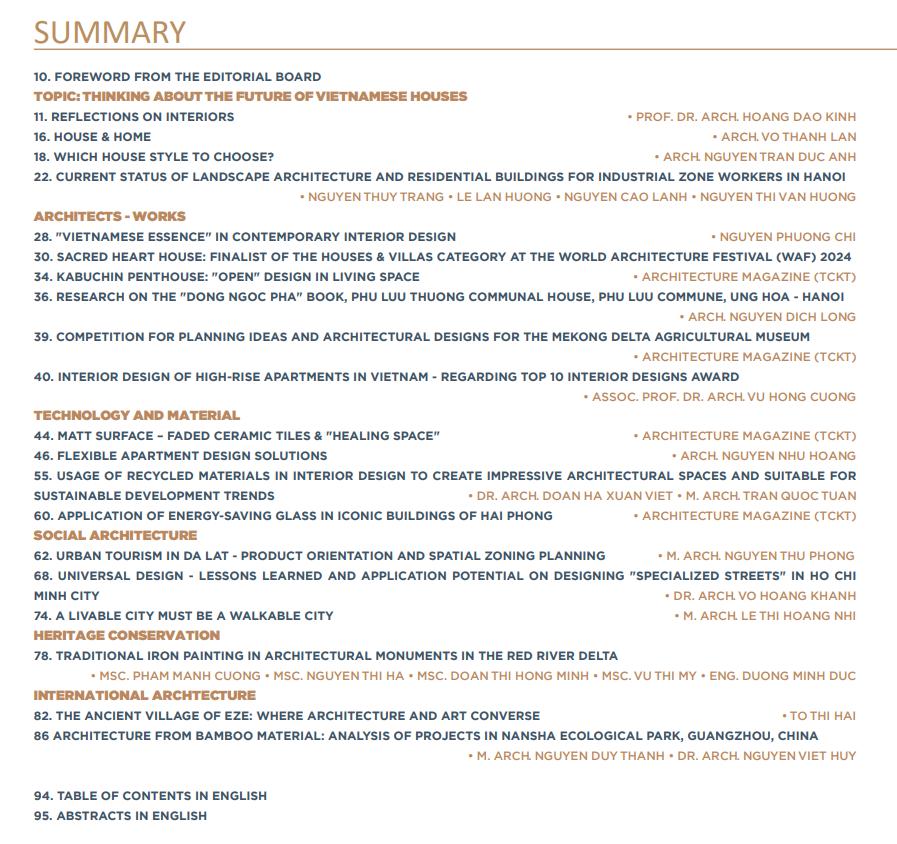
Foreword from the editorial board:
Dear readers,
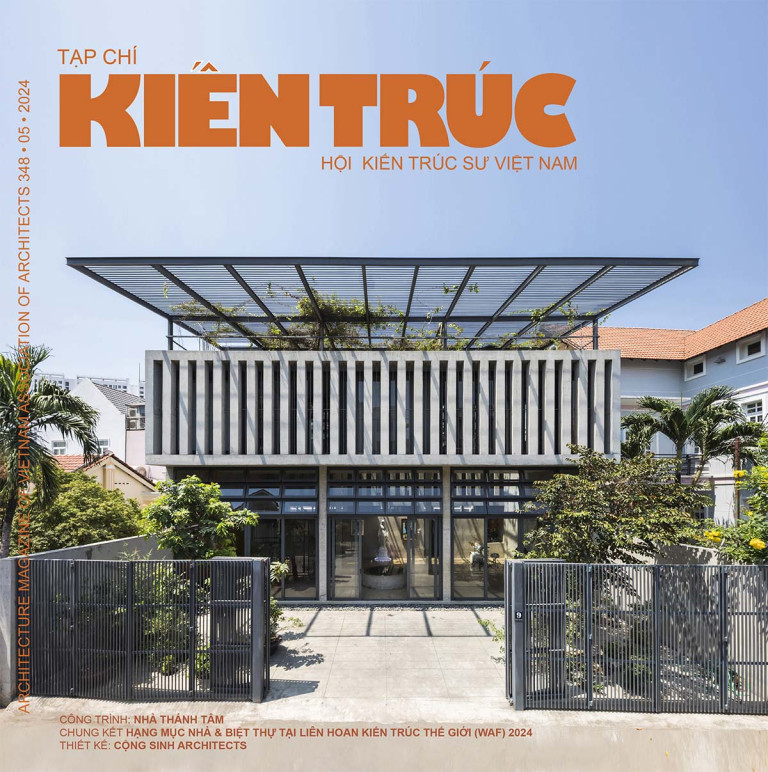
The thematic topics of Architecture Magazine in early 2024 have delved into the realm of housing, from comprehensive studies on housing issues over the past 50 years to the topic of social housing, and the introduction of outstanding housing architecture projects, aiming not only to foster beneficial connections among Manufacturers, Material Brands, Architects, and Users, creating high-quality products and designs centered around people but also to address the core issue: a house is not just a place to live but also a place to express style, embody the soul, and reflect traditional culture within modern architecture. Architecture Magazine issue 05/2024 proudly presents the special issue: “Dream House 2024: Dreaming of Vietnamese Houses” with outstanding articles aimed at exploring Vietnamese architectural styles, honoring creative and practical ideas in the fields of architecture and interior design, and proposing design and technology solutions that contribute to improving the quality of life for people in the future.
Additionally, this special issue marks the launch of the “Dream House” Design Competition, continuing the pursuit of discovering and encouraging innovative design ideas in the field of housing architecture, seeking to promote new approaches that inherit traditional cultural values combined with modern technology, aiming to enhance the living spaces of the Vietnamese people. There may be many more aspirations and reflections on Vietnamese-style housing architecture, but the highlights have already begun to emerge with the projects and works introduced in the Architects – Works section of this issue. We look forward to the new successes of the young generation of Vietnamese architects on the global architecture map.
We proudly present to our readers Architectural Magazine
Issue 04/2024!
Architecture Magazine
Page: 22
Current status of landscape architecture and residential buildings for industrial zone workers in Hanoi
Nguyen Thuy Trang, Le Lan Huong,
Nguyen Cao Lanh, Nguyen Thi Van Huong
After more than 20 years of developing industrial zones (IZs), Hanoi currently has 9 established IZs in full operation, covering a total area of more than 1600 hectares. Among them, only 3 IZs have worker residential housing projects (WRH), with 5 housing projects under construction (some of which are already in use). These housing areas are being built with different scales and investment models, resulting in various structural and characteristic differences. With the direction to continue developing new and expanding existing IZs in Hanoi, along with the need to develop WRH in these IZs, it is essential to research and evaluate the existing WRH projects. This article focuses on assessing the current status of landscape architecture and building architecture of the WRH projects in Hanoi, to highlight the positive aspects as well as the limitations of these housing areas, drawing lessons for the development of future WRH projects.
Page: 28
“Vietnamese Essence” in contemporary interior
Design Nguyen Phuong Chi
In the development of cultural and architectural life, the style of Vietnamese furniture seems to have never been thoroughly researched and analyzed. Consequently, documentation in this field is very limited and lacks systematic organization. Most of the time, we can only find images of furniture through ancient structures or folk houses. Vietnamese furniture, in general, has been heavily influenced by foreign cultures such as China and France. However, there still exist folk furniture pieces that are deeply imbued with Vietnamese identity, such as bamboo beds, stools, wooden platforms, long benches, mats, and cupboards. These items not only possess unique beauty but are also very practical, profoundly reflecting the life and culture of the Vietnamese people. Unfortunately, their value has not been fully studied and promoted so that they can shine and be recognized. It is high time we discussed more about the “Vietnamese furniture style.”
Page: 40
Interior design of high-rise apartments in Vietnam – regarding Top 10 Interior designs Award
Assoc. Prof. Dr. Arch. Vu Hong Cuong
The distinctive and unique interior design styles of Vietnam are still rather vague, and the primary responsibility lies with the actual design works and the designers themselves. Fortunately, when looking at the results of recent architecture and interior design competitions, such as the National Architecture Awards the Top 10 Houses, Top 10 Interior Designs, and Dream House, we can still see the sparkle of works that incorporate selectively modern influences and finest contemporary elements while still preserving and promoting traditional values. This article will focus on analyzing the works that have won the Top 10 Interior Designs from 2021 to 2023 in the “High-Rise Apartment” category, from the perspectives of space organization, shaping techniques, and the use of materials, to preliminarily identify trends in interior design for high-rise residential apartments. As a competition with professional quality endorsed by the Vietnam Association of Architects and initiated by Kienviet since 2021, it has now gone through three seasons with hundreds of entries submitted from all over the country. Top 10 Interior Designs has selected many exemplary interior design works, notably in the residential category, including high-rise apartments. This reflects the robust development of this type in the context of high urbanization today.
Page: 55
Usage of recycled materials in interior design to create impressive architectural spaces and suitable for sustainable development trends
Dr. Arch. Doan Ha Xuan Viet, M. Arch. Tran Quoc Tuan
Research on material technology has been present and sustained throughout the history of human development. Since humans first began using and mastering natural materials such as wood, stone, clay, and metals, there has been a continuous interest in improving, researching, and developing new types and forms of materials. During the period of industrialization, material technology made significant advancements, creating materials that met societal needs and were applied in many practical fields of life. Alongside this development, the demand for sustainable development and the concept of a circular economy posed the challenge of how to extend the lifecycle of products or the materials used to create them. This approach aims to optimize the use of natural resources and minimize negative environmental impacts.
Page: 58
Universal Design? Lessons Learned and Application Potential on Designing “Specialized Streets” in Ho Chi Minh City
Dr. Arch. Vo Hoang Khanh
Universal Design aims to create products, services, and environments that can be easily and effectively used by everyone, including people with disabilities and those with special needs. In urban planning, Universal Design for street landscaping refers to the requirements for physical infrastructure and pedestrian access to enhance accessibility for as many street users as possible. Universal Design principles are extensively and commonly applied in the design of various specialized streets in developed countries. The experiences of applying Universal Design principles to design “Specialized Streets” in several countries provide valuable lessons for improving the design environment of specialized streets in Ho Chi Minh City, aiming to eliminate barriers. In the future, integrating Universal Design with urban design is essential to increase accessibility, safety, and adaptability for users. New standards and guidelines based on Universal Design principles can be proposed for street landscape designs in Vietnam.
Page: 74
A livable city must be a walkable city
Arch. Le Thi Hoang Nhi
The concept of a “livable city” is now widely recognized. A livable city is always the first choice for people when it comes to settling down and establishing a career. Building a livable city often relies on multiple criteria: a safe and sustainable social environment, economic development, reasonable healthcare and education services, and also appealing cultural and identity factors.
One of the criteria to determine the quality of urban life is walkability. For centuries, cars and motorcycles have dominated the streets, influencing the way we plan and develop urban areas. However, cities filled with cars
often appear dull and unattractive, causing people to grow increasingly disconnected. Urban planners have realized the importance of considering the benefits of walkability as a catalyst for creating more livable cities. Thus, a livable city must offer numerous opportunities for effortless walking.
Page: 82
The ancient village of eze: where architecture and art converse
Arch. To Thi Hai
With an architectural complex that bears the distinct marks of classical European design set in a breathtaking landscape, Èze is dubbed the “village of artists,” not just because it is a beautiful village and a French architectural heritage site, but also because it serves as a hub that connects and integrates various artistic activities—from literature, fine arts, music, creative design, to traditional crafts—between the local community and designers and artists worldwide. The journey of discovering beauty in the ancient village of Èze is also an opportunity for us to admire the history of a beautiful land, to live once more with rustic nature, and to converse with the past in a free and joyful manner. Such land will undoubtedly enrich the soul.
Page:86
Architecture from bamboo material: Analysis of projects in Nansha ecological park, Guangzhou, China
Arch. Nguyen Duy Thanh, Dr. Arch. Nguyen Viet Huy
Vietnam has a tropical climate with high humidity and temperatures, ideal for the growth of bamboo, a fast-growing grass species that is the largest in the world. Bamboo is known as nature’s steel due to its strength and resilience. This material has a long history and remains a sustainable choice for architectural projects due to its environmental benefits. Based on analyses of the region’s climatic conditions and practical insights from bamboo-built structures in Nansha Eco Park, Guangzhou, China, an overview of the advantages and disadvantages of bamboo in construction can be provided. This will lead to proposing principles and viewpoints for the appropriate application of bamboo as a material in Vietnam specifically, and in other East and Southeast Asian countries with hot and humid climates in general.