Page: 12
FOREWORD FROM THE EDITORIAL BOARD
Our dear Readers,
The rapid urbanisation has brought an avalanche of consequences to the national socio-economic system and especially “disrupted” the connection of the built environment with the natural environment. In that context, eco-cities emerged as an inevitable need to improve the quality of housing and living environment with regard to the criteria of green and healthy living, and to sustainable development. Eco-cities have their own criteria and principles for planning as well as for architecture: First of all, in order to have an eco-city, it requires to have numerous eco-buildings designed in the context of taking action for the environment and meeting all the requirements as shown in the criteria applicable to a city, and especially to an eco-city.
The Journal of Architecture – October 2021 issue – focuses on eco-city theme under the title “Architecture and its contribution to shaping eco-cities”. Among a variety of aspects, we examine issues of architecture in an eco-city: buildings that meet all the requirements of environment, design in harmony with and close to nature, making full use of natural energy sources and minimising impacts on the environment. These are part of the Declaration of Green Architecture that Vietnam Association of Architects announced in 2012, as an important goal that many professionals have always been striving for in recent years.
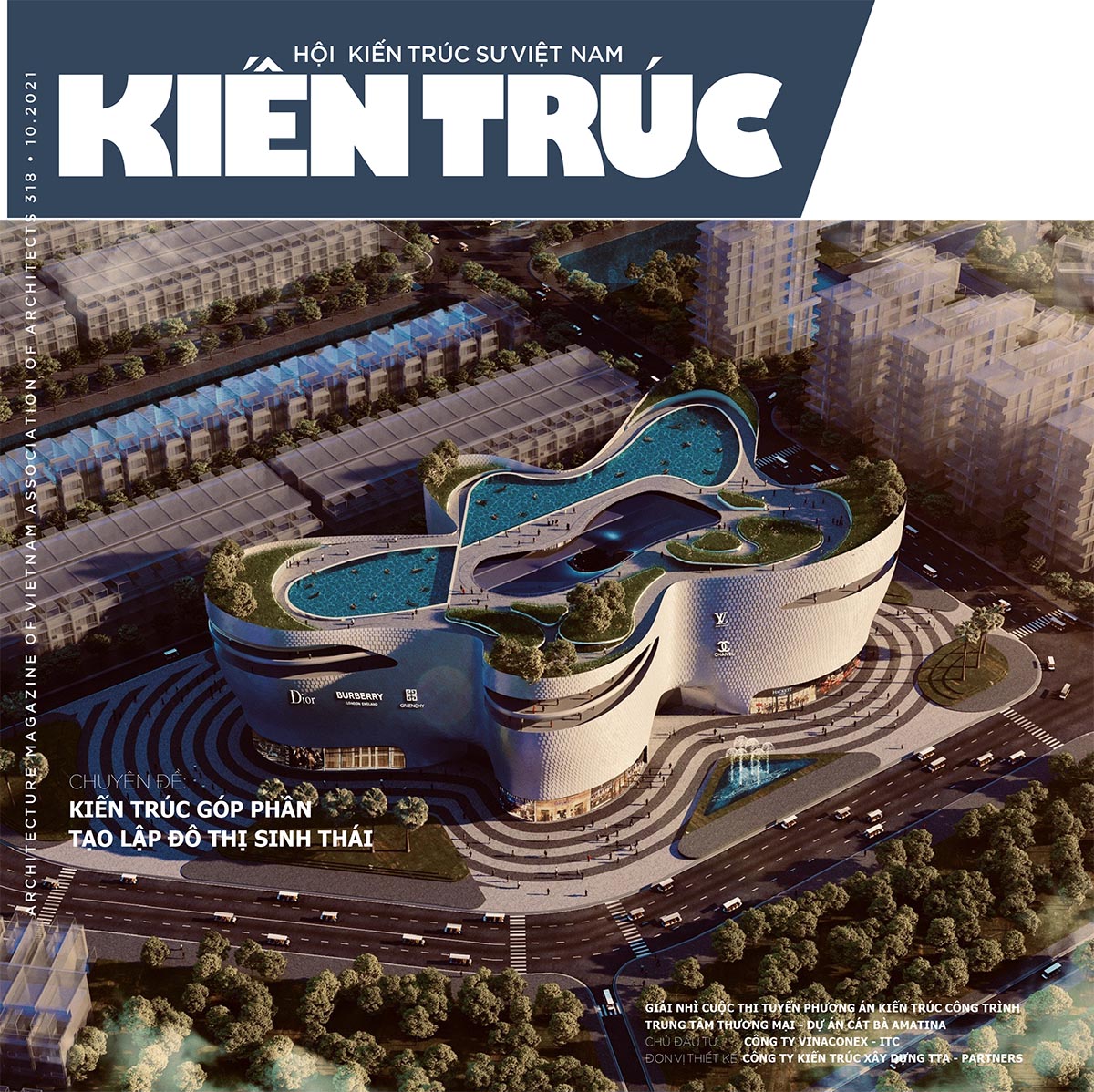
Also with the design criteria associated with nature, the winning projects in two design competitions: Architectural Design for Commercial Centres and Landscape Design Concept on both sides of the river phase 1 – Cai Gia Tourism City Project, Cat Ba (Cat Ba Amatina) organised by the Journal of Architecture – Vietnam Association of Architects – in collaboration with VINACONEX Tourism Development and Investment Joint Stock Company (VINACONEX – ITC) under auspices of Vietnam Association of Architects) has really become the highlight of this issue with its innovative solutions to develop the tourism of Cat Ba Island regarded as one of the natural wonders of the country and region.
The Journal of Architecture – October 2021 issue – provides you with different approach methods to issues of eco-cities and eco-architecture, as stated by an expert: “From eco-architecture to an eco-city, all factors are considered in the design philosophy of living space planned for humanity, convenience, quality and sustainable development”.
It is a great honour for us to be able to introduce the October 2021 issue to you all.
Page: 13
FROM ECO-ARCHITECTURE TO ECO-CITIES
Truong Van Quang
Eco-architecture is actually the design of a small space with quality that does not largely depend on technologies. Eco-city is the creation of a large or very large built environment with good quality, in nature-based principles, where small spaces are systematically planned to shape a whole structure in a connection between the built environment with eco-systems, with environment, with natural or man-made landscape. “Small space” inside “large space”, “small ecosystem” inside “large ecosystem” can be seen as the structure of a large-scale building called city. From eco-architecture to eco-cities, they are all considered in the philosophy of planning and design for people towards convenience, quality and sustainable development.
Page: 16
MODERN APPROACH TO GREEN, SMART, ADAPTIVE AND ECO-CITIES
Tran Lam Ha
Urbanisation is accelerating, resulting in cities expanding their influence, transforming vigorously and having a profound impact on surrounding areas. The concept of “eco-city” proposes an innovative and efficient approach to the design, construction and operation of cities in a way that minimises the devastating effects of human activities in cities on nature. An eco-city does not only create a harmony between development and environment, a balance between buildings and nature, but more importantly, it also has to meet the requirements of environmental protection with positive effects on nature. To achieve this goal, it is necessary to pave the way for and make policies so as to promote and encourage urban planning and design towards green and smart development with urban ecological environment, including good quality of life, economic growth in line with adaptation to climate change, efficient use of energy, ensuring capacity to respond to challenges and returning what we have taken away from the environment and nature.
Page: 19
FACTORS THAT ENSURE THE DEVELOPMENT OF SMALL AND MEDIUM-SIZED ECO-CITIES
Nguyen Minh Hoa
From the end of the 20th century to the beginning of the 21st century, Europe and some countries in North America realised one thing: The development of large cities has encountered something uncertain – In other words, megacities with millions of inhabitants each have so many negative impacts, and moreover, it is very difficult to overcome or control such a development. Therefore, they prefer the development of small and medium-sized cities. Towns and small cities with a population of no more than 200,000 people are prioritised. Such cities have a very good policy in terms of controlling the growth of population, environment, landscape, security and order, and of course city construction. Socially, this type of city is very friendly, almost everyone knows each other. That is why new concepts such as “village city”, “friendly city” emerged.
Page: 21
FROM LANDSCAPE ARCHITECTURE TO BIOPHILIC ARCHITECTURE
Do Duy Thinh – Nguyen Thi Minh Dieu
Human beings have established connections with the natural environment throughout their history of development, from the very beginning of building communities. Urban expansion is constantly forming new patterns of using city space. Urbanisation does not only grow in size but also changes the function of the city, putting many impacts on the socio-economic system and especially causing disconnection in the relation with the natural environment. Design associated with nature – Biophilic design – emerged at the end of the 20th century, once again emphasising the values of nature for human well-being. This approach will also clarify the need to build and restructure residential areas closely associated with nature through specific design patterns and design elements. Design associated with nature is actually a number of solutions that contribute to solving urban problems and gradually become a principle in reaching the goal of sustainable development and green development.
Page: 25
DESIGN OF CITY CONCEPTS AND ADAPTATION OF HIGH-RISE BUILDING ARCHITECTURE IN ECO-CITIES IN VIETNAM WITH FOCUS ON VERNACULARITY
Phan Dang Son
In summary, the creation of an eco-city – or generally a green city – is a reasonable development for Vietnam. It is a pathway and a decision made at the right time for the future and integration of the country. First of all, it is for the well-being and safety of the community, and at the same time a promotion of a balance between economy and ecology for a city. In Vietnam, the unique cultural characteristics of each region also offer a greater opportunity for such a shaping. The solution to improvise high-rise buildings in eco-cities around the world, in which Architecture is the number one requirement, has been going on vigorously, with both success and failure. It is a valuable lesson for us in Vietnam to choose the most appropriate development scenarios, which are both universal worldwide, and interesting for architects to explore a new land where traditional culture is abundant for creativity. It promises to be a huge opportunity for professionals to find their ways.
Page: 32
SPATIAL DESIGN OF HIGH-RISE OFFICE BUILDINGS IN HO CHI MINH CITY TOWARDS ECO-ARCHITECTURE
Le Thi Hong Na – Ta Cong Tien
High-rise Office Building (HOB) is becoming a hot trend in Ho Chi Minh City (HCMC) due to the increasing demand for offices for lease. With HOB, in addition to a convenient location, an important architectural solution that affects quality and efficiency is a unique, modern, reasonable and natural organisation of space. Biophilic design is a systematic application of solutions in order to create spaces that are friendly to both people and the natural environment, improving comfort and ensuring well-being. This study focuses on solutions to organise spaces in HOB in HCMC in view of biophilic design. Some typical theories and case studies on biophilic design in the world were introduced. Fifty HOBs in some central districts of HCMC were surveyed and evaluated. Since then, the types of functional spaces of HOB in HCMC were identified and classified. Finally, nine biophilic design solutions are proposed for six main functional spaces of HOB in HCMC.
Page: 43
FROM GREEN BUILDINGS TO GREEN CITIES – SOLUTIONS TO SUSTAINABLE DEVELOPMENT GOALS
Luu Thi Thanh Mau – Le Thi Hong Na
In this paper, a number of lessons learned on green building practice are clarified through the analysis of the empirical project of Diamond Lotus Riverside high-rise apartment building. Next, the green standards for assessment and recognition of urban areas (LEED-ND, CASBEE-UD) and typical models of green urban development in the world are introduced. Finally, the criteria for building a new green urban area model are proposed for application in the design of a new urban area planning and construction scheme towards sustainable development in the current context of Vietnam. Thus, a panorama from green buildings to a green city will be presented and discussed towards sustainable development as the ultimate goal.
Page: 48
“CITY WITHIN CITY” – THEORY AND PRACTICE
Pham Hung Cuong – Tran Quy Duong
The orientation to re-adjust the overall development planning structure of Hanoi city proves to be urgent. Urban structure concept of “city within city”, if properly understood, shall be “a multi-pole, multi-centre structure with large-scale polarity”. This is a strategic, important and relevant orientation for transformation as demonstrated in the task of adjusting the master planning of Hanoi city to study.
There may also be difficulties due to having to overcome the limitations of the existing planning structure and orientation, so that the transition in planning will causes less conflict and damage. But it is absolutely necessary to ensure that Hanoi will go ahead and achieve sustainable development in the next 20 – 30 years based on a well-established foundation.