

Page: 10
Foreword from the editorial board:
Dear Readers,
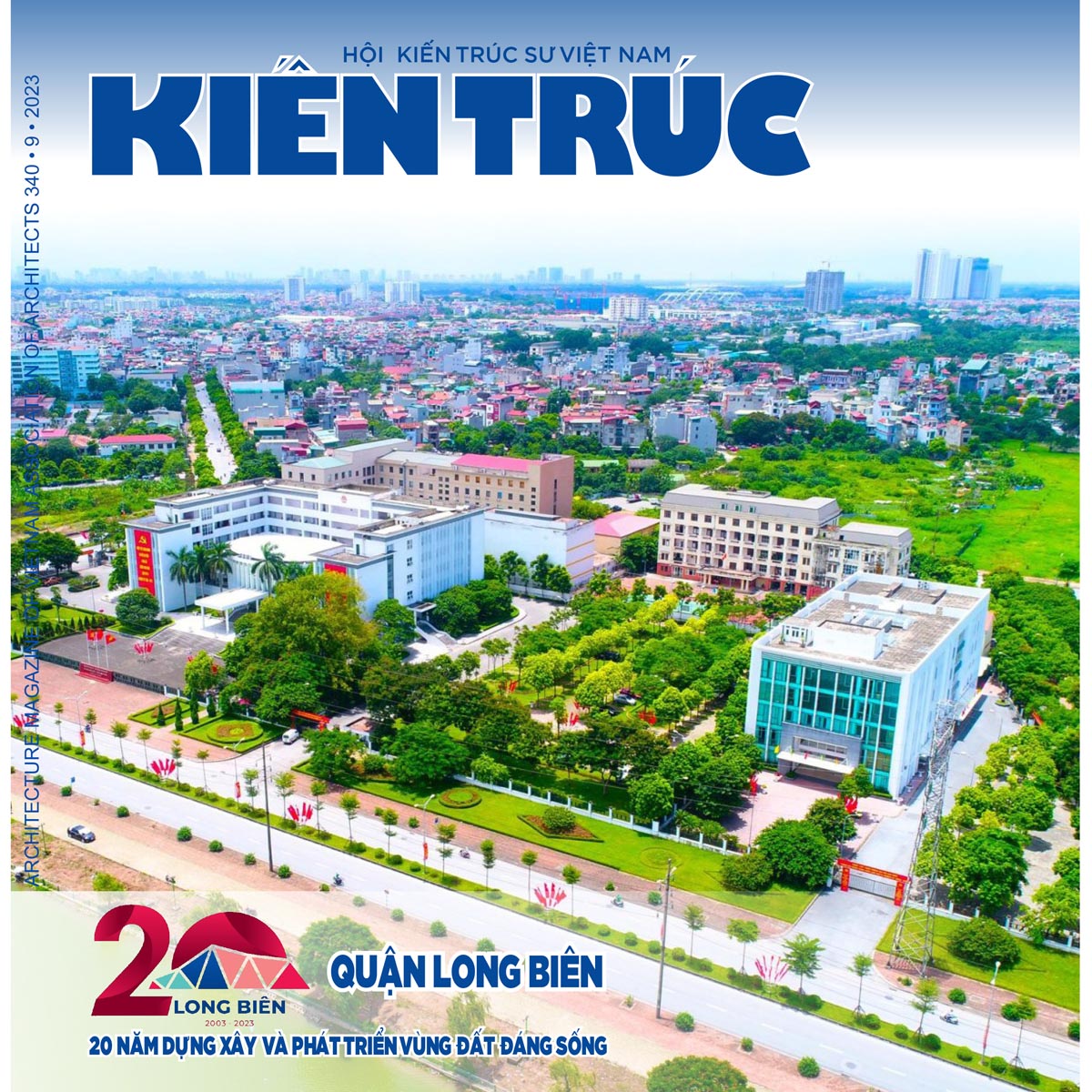
As a district situated in the northeast of the capital city, Long Bien has a rich history and significant potential for development. The formation and progress of Long Bien over the last 20 years have been closely tied to the development of Hanoi in its industrialization, modernization, and international integration.
Architecture Magazine – Vietnam Association of Architects is honored to accompany leaders at all levels, various sectors, and the people of Long Bien in a special issue titled: “Long Bien District: 20 Years of Construction and Development in a Livable Region.” This special issue of Architecture Magazine will gather experts from various fields such as culture, history, urban planning, architecture, to look back on the journey of development and numerous achievements of Long Bien. It will showcase significant activities and exemplary projects while sharing valuable urban management experiences, to continue to strive for successes in Long Bien’s sustainable development.
A 20-year journey might not be an extensive period, but Long Bien District has left a lasting mark on the construction and development journey. It has asserted its collective contribution to the overall socio-economic development of the capital city in recent years.
In addition to the special issue, other articles in Architecture Magazine will provide perspectives on urban architecture, emphasizing ecological architectural approaches, utilizing indigenous and natural elements, agricultural development, and environmental preservation. These valuable insights become invaluable lessons for urban development within the context of global integration in Vietnam.
This special issue of Architecture Magazine serves as an expression of congratulation and gratitude to the Party, the municipality, officials, and the people of Long Bien for their efforts in contributing to the common development of the capital. It also aims to create creative and sustainable spaces, ultimately working towards building an increasingly developed, modern, and authentic Long Bien District.
We sincerely present to our readers Architecture Magazine Issue 09/2023!
Architecture Magazine
Page: 11
20 Years of Building and Developing a Modern, Livable Long Bien District – Toward the Future
The practical experience of 20 years of building and developing Long Bien District has left three valuable lessons for the District’s Party Committee: (1) Unleashing the district’s potential and advantages; taking the initiative, being creative, thinking boldly, acting resolutely, and taking responsibility for common development. (2) Placing a strong emphasis on building a clean and strong Party organization, developing an efficient and effective political system. (3) Nurturing the unity of the entire population, focusing on mobilizing the masses and grassroots work. The achievements obtained serve as motivation, a strong source of encouragement, and an important foundation for Long Bien to continue confidently on the path of renewal, toward new heights, deserving its rich traditional heritage and extraordinary geographical location.
Twenty years, a relatively short journey, but the achievements of the Party, the government, and the people of Long Bien District are truly impressive and something to be proud of. These achievements are a vivid testament to the district’s potential and aspirations to become a sustainable, cultured, modern center in the north of Hanoi, a truly livable place.
Page:17
Long Bien Bridge – Preservation for Contributing to the New Hanoi• Dr. Arch. Phan Dang Son
Long Bien Bridge serves as the link between three centuries in the heart of Hanoi, and thus, it deserves to be recognized as an essential urban heritage within the city. Nowadays, Long Bien Bridge has become an integral part of Hanoi, a captivating symbol known across five continents, where its spirit carries profound historical, cultural, social, and human values. Hence, the planning and preservation of Long Bien Bridge is a significant task for those who love Hanoi, as well as for authorities, professionals, and the community.
As Hanoi embarks on new urban planning, with a focus on the core being the Hong Ha River, featuring ecologically-oriented development and green parks running along both sides of the river connecting to midstream areas, the opportunity for preserving and respecting the heritage of Long Bien Bridge becomes more real than ever. Investing in the restoration and repurposing of the bridge may not require or should not depend on external funding: a decrease in the preservation and utilization budget is likely if the bridge is no longer used for its main traffic connection function. Therefore, feasibility, including the option of socialization, can be achieved more harmoniously and easily. In terms of architectural planning, discussions should not be prolonged, and it is essential for specialized professionals with the appropriate expertise to engage actively in specific implementation, serving as the foundational framework.
Page: 25
Identifying Long Bien: An Open Heritage
• M. Arch. Nguyen Truong Quy
This article surveys historical and cultural heritage data in Long Bien District (Hanoi) in search of symbolic possibilities for the logo an administrative district at Hanoi’s gateway.
Long Bien is a young district of Hanoi but resides on ancient land. The toponym “Long Bien” derives from a historical origin present in the early settlement processes of the ancient Vietnamese. The land itself, situated opposite Hanoi’s old city across the Red River, was once part of the Kinh Bac region, known for its prosperity among the four precincts around Thang Long – Ke Cho. This location served as the nearest gateway from the border or the sea to the capital city, accessible by both road and waterway routes. In modern times, when this land belonged to Gia Lam district, it left an early imprint of modernization through its railway system, bridges, airport, and factories. These factors together make our navigation to identify Long Bien a matter of symbolization of heritage.
Within the scope of this survey, the concern about heritage symbolism emerged notably during the Long Bien District Logo Creation Contest. It became a pivotal element as documents and discussions tended to lead toward heritage preservation. This article will sequentially explore the communication spaces created by this heritage under the categories of legendary heritage, the cultural and religious contents associated with Long Bien, material vestiges bearing heritage values, and cultural references that contribute to establishing a communicative symbol for the concept of a region undergoing differentiation.
Page: 28
Suggesting a Development Planning Strategy for Long Bien District – Hanoi
• Dr. Arch. Phan Bao An • Dr. Arch. Nguyen Lam
• Eng. Nguyen Thi Thuy Hang
This article analyzes the development planning in context, drawing similarities from case studies such as Thu Duc City in Ho Chi Minh City, Pudong in Shanghai, and suggests applying the lessons learned to Long Bien District. Additionally, based on the existing potential and strengths of Long Bien District, the authors propose four developmental pillars: “A Knowledge City, An Environmental City, A Cultural City, A Health City,” to transform Long Bien into a livable city that is globally competitive.
Page: 36
Exploring the Potential for Sustainable and Creative Urban Space Development in Long Bien• Dr. Le Quynh Chi
Situated in the northeastern part of the capital city, Long Bien is a land with a rich history and significant development potential. Alongside long-standing cultural and historical values like traditional village systems and crafts such as fan-making, weaving, and net knitting, and valuable heritage sites like Hoi Xa Commune’s communal house and pagoda, and long-running festivals like the ‘Ai Lao’ singing-dancing, Long Bien is also home to the vibrant life of new residential areas, such as the high-end Vinhomes urban area and Viet Hung urban area. These areas are characterized by the intersection of multiple cultural layers, where old villages blend with new urban residents and different social strata meet, creating a potential land for nurturing creative activities. Therefore, it is essential to identify and establish the spatial infrastructure for creative activities in the district, including:
- The national-level cultural industry digital resource center.
- Creative spaces/hubs in the region: adaptively reusing factory spaces.
- Creative agricultural spaces.
- Creative streets and avenues.\
Page: 40
The Village Imprint in the Urban Development of Long Bien District• Arch. Nguyen Phu Duc
Urbanization in Vietnam primarily stems from traditional villages. Long Bien District is no exception to this developmental pattern. Given its strategic location as the eastern gateway to Hanoi’s city center, controlling the rapid urbanization in the district is essential, to ensure the preservation of its unique character while simultaneously shaping a modern and distinctive urban landscape.
Page: 44
Green Corridors and the Challenge of Sustainable Urban Development along the Banks of the Red River and Duong River
• Dr. Arch. Vu Hoai Duc
Long Bien District’s natural landscape is gracefully enveloped by the two largest rivers flowing through Hanoi’s urban heart: the Red River and the Duong River. The riverside areas present a complex challenge, as they demand the control of urban development to ensure flood resilience while also unveiling the potential for a sustainable landscape development in Long Bien District.
Page: 72
Learning about the application of hyperbolic paraboloid curved surface in the design of the thin-shell concrete roof
• Dr. Arch. Le Thi Phuong Chi
In the history of architectural development, geometry has always been the shaping basis for design, especially modern design to ensure the science of structure and feasibility in construction. A hyperbolic paraboloid is a doubly curved surface that resembles the shape of a saddle with a special structure. Along with its aesthetic dynamism, it has also proven to be structurally effective thanks to its ability to cover a long distance without intermediate support. This distinctive form is the result of the advances in modern architecture and structural engineering, in keeping with the thin-shell concrete roof, which has been and is being used by architects, structural engineers, and academics around the world for modern design. Author Tyler S. Spague (University of Washington, USA) once described the Hyperbolic Paraboloid structure as ” Beauty, Versatility, Practicality “. This article introduces the concept and characteristics of the Hyperbolic Paraboloid surface, its compatibility, development history, and typical applications in thin shell design in the world.
Page: 93
Preserving and Adapting Architectural and Urban Heritage from the French Colonial Period in Vietnam in a New Context
• Dr. Arch. Nguyen Quoc Tuan
Urban heritage from the French colonial period in Vietnam has been relatively studied and assessed in cities such as Hanoi, Ho Chi Minh City, Hai Phong, Da Lat, Hue, but it has not been systematically summarized nationwide. It is essential to select suitable methods and tools to analyze and evaluate the characteristics and values of the neighborhoods established during the French colonial period in major Vietnamese cities. This process helps provide a more accurate assessment of the preservation potential of colonial-era heritage within the framework of modern urban development and leverage the values of this heritage in cultural heritage tourism strategies and economic development.
In reality, “Adaptive preservation” is no longer a foreign concept in many urban heritage areas worldwide. Urban heritage from the colonial period in Vietnam will not be an exception. To effectively protect and harness the values of this heritage, choosing adaptive preservation methods is the appropriate direction for urban development in Vietnam.





