

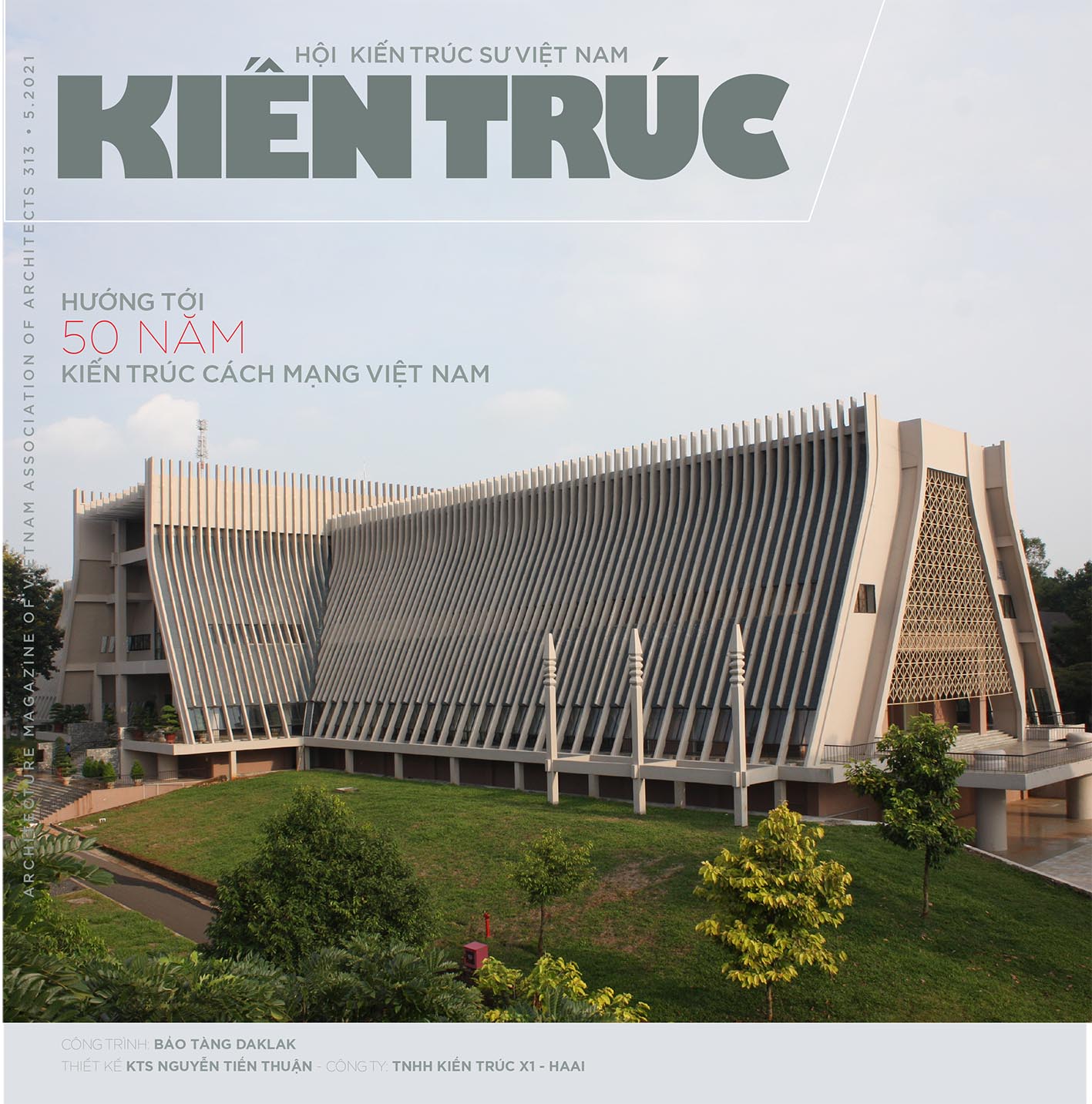
Page: 18
FOREWORD FROM THE EDITORIAL BOARD
With the spirit and the feelings when the summer has come with various fruits which the professionals have always kept in mind, the Journal of Architecture would like to bring all the thoughts, enthusiasm and concerns together that many architects from generation to generation intend to share. We will see the achievements in urban planning and building design from across the country and some projects in particular places. We will also get to know some viewpoints of the past and future development of architecture. There are numerous considerations from different perspectives on identity and modernity, and the questions in Vietnamese architecture remain unanswered after almost a century. Some articles deal with the problems and even failures in architecture after such a long time. We hope that this multiple theme can provide our readers with brand new thoughts.
In this issue, shaping a creative city for the capital city has been clearly reflected and well addressed. Walking through the capital city for almost half a century in peace is really interesting. However, we must stay awake, because there are still many gaps to fill, even when the city was recognised by the UNESCO as “a city for peace” and “a city of creativity”. Then, the articles will pave the way for Hanoi to achieve the title creative city and creativity will take the city by storm. We just think about advertisement boards which make the cityscape look chaotic. Should they be called “trash”? If they were gone with the wind, the city would be so elegant and charming.
Page: 19
TRENDS IN VIETNAMESE ARCHITECTURE FROM 1975 ONWARDS
• Vu Hiep
Looking back at Vietnam’s traditional architecture and fairly comparing it with architecture of the neighbouring countries, such as China and Japan, the Vietnamese in the past were able to match the other nations in terms of aesthetics and ideology (only the scale was smaller). When Japan was reconstructed after the war (1945), after 35 years (1980), Japanese architecture began to become powerful in the world by expressing international modernity on the basis of the uniqueness of national traditions, which would be different from the Western tradition. The Japanese also had many theorists in architecture, the most prominent could be Kurokawa with Metabolism. China rose from the ruins of the Cultural Revolution (1976), also about 35 years later (2012), China won the first Pritzker Prize, and became a meeting and testing place for world-leading architects, with typical works of contemporary architecture. As for Vietnam, since Doi Moi (1986) until now (2021 – 35 years have gone by), we have not yet had a world-class architect, and unable to attract the world’s leading architects to come and experiment their ideas. It is not possible either to break through modernity with the spirit of national traditions, yet to create a new architectural theory that is globally sufficient. That is what makes any Vietnamese architect with a sense of responsibility to society – the country cannot help but worrying about the situation. The answer is left open to you.
Page: 29
LOOKING AT THE PROBLEMS OF VIETNAMESE ARCHITECTURE OVER ALMOST THE PAST 50 YEARS
• Phan Dang Son
The success of Vietnamese Architecture within almost half a century, from the day of national reunification until now, can be regarded as “fully secured” and “radiant”. These results seem to cover all the aspects of Architecture: Planning, building design, critique and theorising, research – training; legalising, etc. There have been many leading experts, cultural researchers, investors and politicians who analyse, evaluate and clarify the development of architecture. In addition, scholars have also reviewed at different levels the problems of architecture. To be frank, I would like to contribute my personal views to this aspect and integrate research projects carried out by experts, in order to go further.
Page: 35
ORIENTATION THAT STARTS WITH A VISION
• Nguyen Thuc Hoang
In the distant future (25 years), the Vietnamese society will develop significantly, and a new generation will emerge. The quality of life will not be just enhanced, but lifestyle will also change, and the community should be better organised and managed. This change can be most clearly seen in the city’s infrastructure systems, in which planning and construction continue to be an important factor. They should be adaptive and visible.
In order to establish the development orientation of urban planning and building, first of all, it is necessary to determine the vision of that future in the city development.
Page: 37
AN APPROPRIATE TREND OF DEVELOPMENT FOR HO CHI MINH CITY IN THE NEW ERA
• Nguyen Huu Thai
In order to make a real breakthrough for development and restore its role as a major economic centre, Ho Chi Minh City must become the core in the East Mekong River Delta metropolitan region. This is a huge challenge and also a new issue to us. Of course, many policies, measures and roadmaps are still needed to achieve this goal, but in general, they must be appropriate for the local context and meet the following requirements: Establishing effective management and administration for the metropolitan area; ensuring sustainable development of a megacity in the context of environmental crisis and fierce global economic competition. The megacity must also provide good living conditions in terms of jobs, services, infrastructure and social policies, such as how to make the poor and the underprivileged live in the megacities so that they can have jobs and benefit from services, for instance healthcare and education.
Page: 72
AXIAL SYMMETRY OF BUILDING DESIGN
• Ngo Nam Phuong
In the history of design applicable to buildings, interiors, furniture, appliances as well as decorative arts, axial symmetry has always been discussed, used, analysed and evaluated. Design thinking whether this is a formal expression of the object to be designed or a core feature of the content should be of huge interest. Today, modern design, under many influences, is somewhat blurring that boundary line. However, the design of architecture and interior spaces always learn something about the forms of symmetry that may change to adapt, inherit and develop. This is the thread that connects the ideas for a particular space. Balance, sustainability, harmony, cohesion in this man-made environment, etc. from the very beginning have always been a standard of development.
Page: 52
PLANNING PEDESTRIAN STREETS IN THE WORLD AND EXPERIENCE FOR DEVELOPING PUBLIC SPACES IN HANOI
• Nguyen Hai Van Hien
• Nguyen Quang Minh
Public space plays a very important role in shaping space and organising/managing activities of any city. In the world, in central areas and especially in the hearts of big cities with a long history, public space even demonstrates its roles and values in contemporary city life, making contributions to the attractiveness of the place in order to better meet the needs of the local community in their daily lives and enable the development of tourism. Among these public spaces, a pedestrian street is an outstanding example, because it helps connect many different spaces and highlight the characteristics of the area. A number of examples from a number of cities in Germany, Denmark, Spain, Japan and the case of Hoi An town in Vietnam have been selected and analysed, thereby drawing out some key points that need to be investigated and applied to the historic inner city and some other central districts of Hanoi.
Page: 57
STUDIES ON THE HUMAN ECOLOGY IN PUBLIC SPACE PLANNING AND DESIGN – CASE OF RE]]PEDESTRIAN ZONE ALONG 131 ARCHWAY TRAIN BRIDGE FROM PHUNG HUNG STREET TO LONG BIEN RAILWAY STATION, HOAN KIEM DISTRICT, HANOI
• Doan Minh Khoi
• Doan Minh Thu
• Pham Hong Viet
In recent years, major cities in Vietnam such as Hanoi, Ho Chi Minh City and Da Nang are all aiming to develop public spaces in the city centre to meet the needs of the community and to develop tourism. In the historic inner city of Hanoi, there has been a disturbance in the relationship between people and the natural environment, as well as between people and the social community. The common situation that Hanoi is facing does not only show the lack of space for community activities, but demonstrates also the fracture in the connection between elements in the human ecosystem. Public space development projects are often prioritised by the government, but have not yet offered any conditions or opportunities for connection between humans, nature and socio-economic factors. Development projects can even disrupt the structure of existing biological and human ecosystems. Therefore, it is important to connect sustainable symbiotic relationships of ecosystems and especially the human ecology of public spaces.
Page: 70
PROMOTION OF THE COMMUNITY’S ROLES IN THE MANAGEMENT OF LANDSCAPE ARCHITECTURE IN HANOI OLD QUARTER
• Pham Tuan Long
There are new solutions as summarised from management practices in order to adapt to the requirements of the society and urban development. It requires that superior management agencies should facilitate the experimentation of new solutions. State agencies, universities, research institutes and experts in urban management need to participate in supporting the proposal of new initiatives that can be applied in real life – For a greener and better developed Hanoi and that people will be satisfied with happy lives.
Page: 61
SMALL-SIZE BUILDINGS FOR PUBLIC SPACE DESIGN IN HOAN KIEM DISTRICT
• Tran Minh Tung
Hanoi city in general and Hoan Kiem district in particular have organised a number of design competitions for public spaces and the results prove to be very positive. The submissions have found new ideas, made suggestions and proposed very practical solutions for urban equipment and small-size buildings which can be transferred in practice. However, perhaps those competitions and awards are only known among professionals, and the application in real life still depends on the authorities or investors. Should it be better that we need to look back at the actual role of small buildings in spatially organising public places so that more effective solutions could be found to realise those ideas and to enrich the cityscape as well as the community life.
Page: 85
SOLUTIONS TO LANDSCAPE PLANNING FOR THE DINH RIVERBANKS IN PHAN RANG – THAP CHAM CITY, NINH THUAN PROVINCE IN VIEW OF RESPONSE TO CLIMATE CHANGE
• Phan Bao An
• Nguyen Thuc Linh
It is urgent to study the current situation, evaluate and develop an appropriate urban development concept for Ninh Thuan province in the context of increasingly extreme climate change. The article aims to identify urban characteristics on both sides of the Dinh river in Ninh Thuan and propose a climate change responsive urban development concept, thereby making a contribution to (1) the orientation of sustainable development for the city; (2) the creation of a unique feature for the city, (3) the enhancement of landscape and land value in the area, ensuring the rational land use; (4) the creation of an urban space that contributes to the city’s tourism development and (5) the protection of the environment from the negative impacts of climate change, drought and flood situation of Ninh Thuan province in the coming years.
Page: 91
MICHAEL GRAVES AND “NEW YORK FIVE”
• Le Thi Nguyen Nhung
• Le Hoang Phuong
Michael Graves is one of the most famous and talented architects of the 20th century. His reputation also comes from classic product designs applied in the daily life of the American people to this day.
He is a member of the “New York Five”, a group of architects believed to be the giants who redefined Modernism in the 1970s. Interestingly, he is also considered to be one of the most outstanding architects representing Post-Modernism in subsequent years.
See more: https://www.tapchikientruc.com.vn/tap-chi-kien-truc/tap-chi-kien-truc-so-01-2021.html
© Tạp chí Kiến trúc





