Page: 14
FOREWORD FROM THE EDITORIAL BOARD
Our dear Readers,
In 2004, UNESCO established a global network of creative cities which facilitates experience exchange activities worldwide. Hanoi has been a full member of this network since 2019.
A creative city is a place where people with their creativity are regarded as an important resource, making the society wealthier and the infrastructure stronger for creative activities, hereby attracting a greater number of creative workforce and providing more creative products.
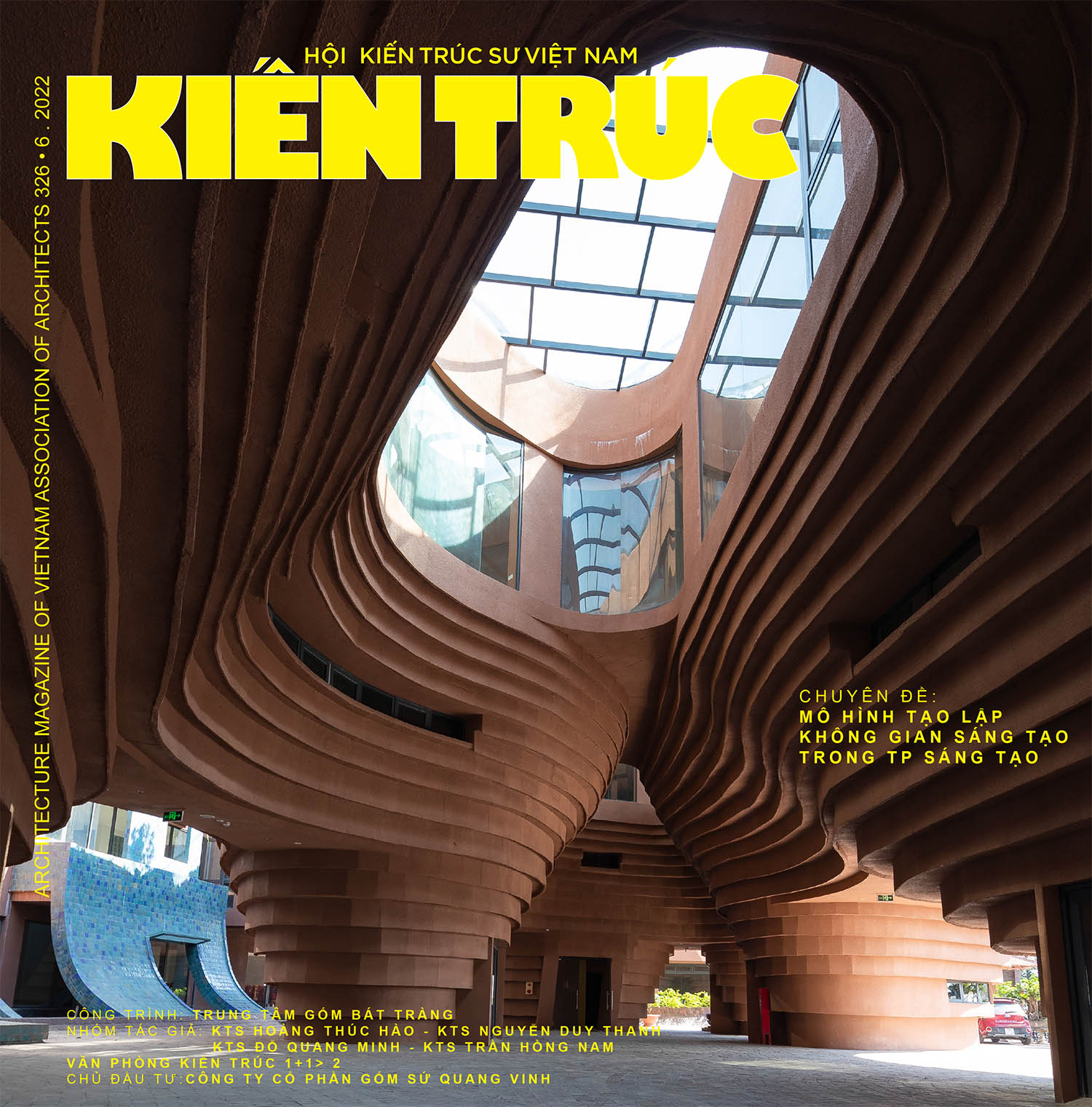
The Journal of Architecture – June 2022 issue – introduces to you the following theme “Concepts for creative spaces in a creative city” with various perspectives on creativity, foundations to establish creative spaces, creative hubs, creative cities, etc. Even when we agree that creativity is a prerequisite for development, we should understand that each city or each country, or even a place, is a special case, thus there is no one-size-fits-all concept.
That is a challenge for all policy makers, planners and architects, but also an opportunity to achieve true creativity. Therefore, the works introduced in this issue emphasise and highlight originality or uniqueness as an integral part of creativity and creative design.
Considered to be “silent avant-gardes” on the road, architects and experts propose solutions in urban planning and urban designs for a creative city with spaces encouraging multi-culturalism, various meanings, public integration and participation. Particularly significant for a city – in view of creative designers – is the thinking that “creative spaces in a city are just like living creatures. They are born, grow up, die away and then revive. Thus, creative spaces cannot be planned at the beginning. Their development in reality requires public participation, people from all walks of life”.
This is the key idea of the Jounal of Architecture’s June 2022 issue. We hope to attract the attention from specialists and all those who are interested in this theme. Together we will participate in shaping creative spaces in creative cities for today and for the future development towards sustainability.
It is our honour to introduce to you the Journal of Architecture’s June 2022 issue.
The Journal of Architecture.
Page: 15
CREATIVE CITY DEVELOPMENT POLICY: ORIGINS AND CHALLENGES
• TA ANH DZUNG
Like other development concepts, creative cities are cities that serve people. The creative city is therefore not a place reserved only for a group of people who are said to be “Creative Pioneers”, but a city that
knows how to take advantage of creativity from everyone in the society, to shape an identity as a separate and unique factor. Unlike Florida, what the author wants to emphasise here is that creativity is not only found in artists, engineers, entrepreneurs or any other people doing intellectual work, but creativity exists in everybody. As Landry and Bianchini once stated: A creative city is a city that benefits all, and the challenge of a creative city is to reconcile different types of creativity, and to see what seems to be opposites, and what should be removed as part of the whole.
Page: 18
INNOVATION AND START-UP ENTERPRISES – NEW SOCIAL STANDARDS IN THE 4.0 REVOLUTION
• PHAM DINH TUYEN & NGUYEN MINH HIEU
Start-up innovation is associated with the achievements of the 4.0 Industrial Revolution, which is creating new products, new organisations, and new social as well as cultural values. Starting a business is not only about establishing a business concept with financial success, but also starting to serve individuals, communities and countries, solving problems relevant to people and sustainable development.
In the past, during the battle for independence and reunification, in 1945 – 1975, President Ho Chi Minh set a noble standard for the whole nation: “Nothing is more precious than independence and freedom”. Since then, the young generations have built their own standard: “Life is the most beautiful on the front lines of fighting the enemy”.
Today, in the era of development and integration, “Standing shoulder to shoulder with the world powers”, at the beginning of the 21st century, many Vietnamese young people have also raised questions about new standards in society to go ahead.
Page: 31
CREATIVE SPACES IN CREATIVE ECONOMY: IN NEED OF A WELL-ESTABLISHED SYSTEM FOR A LONG-TERM HEALTHY DEVELOPMENT
• TRUONG UYEN LY
Creative cultural spaces in Hanoi or Vietnam in general have not yet properly developed. While it can have a huge impact on the society through the nurturing of creative talents and ideas that can help change the whole area in many ways, such as image, brand name and landscape. But life is often short, many of such spaces disappear in less than three years, not strong enough and too vulnerable to stand both objective and subjective challenges, such as change or loss of location, lack of legality, excessively high rental rates, lack of management skills, entrepreneurial skills, limited financial resources, large dependence on funding, a small creative art market, the role that the state plays is not clearly defined or
systematically specified. The creative festivals turned out to be vibrant, the above- mentioned phenomenal burst-out point in Hanoi is just an initial and preliminary movement of the so-called creative economy. Such cooperation helps to inspire, bringing creative opportunities to talents, attracting the public attention, and calling for sponsors and investors to start considering and using resources for developing new talents, skills and creative ideas. However, there is still a lack of a methodical and transparent system to help develop creative spaces towards sustainability and well-being.
Investing in art talents and creative ideas, in addition to economic benefits, has shown great educational and social significance, requiring a long-term vision, consistency as well as the ability to allow failures and trials. This work involves the participation of all three parties: State, enterprises and creative communities.
Page: 35
“NEST” OF CREATIVITY• NGHIEM QUOC CUONG
Hanoi regards the Red River as its central landscape axis. The heart ofHanoi is also the place where most of the cultural and creative spaces can befound. Is that the right place to create a “Nest” – Including both “hardware” and“software”. “Hardware” is a specific location, which can be a building, a street,or an area. “Software” consists of: Creative workforce; innovative knowledgesystem; access connection system; … The “nest” is a place of incubation -nurturing – watching sub-networks – Like a mother full of love. The “nest” is theplace to select, forge, train, and go side by side with those sub-networks – Likea sharp “mentor” who has always been known for having strategicthinking.
Page: 39
URBAN DESIGN IN SQUARES AND PUBLIC SPACES IN THE HEARTOF HANOI CITY• PHAM HUNG CUONG
It is still possible to use Urban Design solutions to create new functionaland aesthetic values for squares in the historic inner city of Hanoi. Solutionsfor basements, skew levels, extra spaces, orienting spaces, refurbishment,etc. can all be implemented with minimal demolition or displacement asintervention but they are still highly efficient.Currently, there is a lack of policies to attract more investment in urban squaredesign. Therefore, it is necessary to receive greater attention and investment ofthe districts and the city to step by step carry out an urban design projects.
Page: 42
CREATIVE CITIES AND FORGOTTEN SPACES• NGUYEN THI THUY VAN
Creative cities are currently one of the key strategies and visions for urbandevelopment. Creative cities regard creativity as the driving force for sustainableurban development. Creativity not only focuses on art but also creativity inscience and technology, creativity in developing solutions for social structure,creativity for city organisations, etc. The association with places and spaces isoften based on the creative setting and atmosphere in the cities that togethermake the “Image and Soul” of the city (Helbrecht, 2004 and Landry, 2006). Theneed for possibilities for experimentation and creative use that can be realisedin neglected spaces in the urban fabric – It is a prerequisite for an innovativecity. In a figurative sense, “forgotten” is used in the sense of falling out of theconsciousness of the community, from the “covetous” eyes of financial investors,and from the vision of the “new city” planners. Literally, they are “free spaces”,unaffected by political statements and markets, and thus they become the sourceof new ideas in a creative city.In every era, there are always talented people. They start up businesswith innovation and will become the new generation of talented people for astrong and long lasting Vietnam.
Page: 60
APARTMENT BUILDING DESIGN QUALITY STANDARDS IN SYDNEY(AUSTRALIA) AND LESSONS LEARNT FOR VIETNAM• TOAN NGO
It is expected that apartments will be home to about 60% of the populationby 2030 and become a popular building trend in the fastest-growingurbanisation in the human history. Therefore, the design of apartmentsin accordance with the urban city life tempo is one of the developmentopportunities and will affect the quality of life of many people to a certainextent. Depending on local conditions and traditions, the developmentbecomes even more recognisable when regulations directly affect thedevelopment of this type. We would like to present an example of apartmentbuilding design in New South Wales (NSW) Australia, to demonstrate howthe shaping regulatory framework evolves over time and influences urbandevelopment.
Page: 80
PLANNING AND DESIGN OF PEDESTRIAN STREETS INCENTRAL HANOI• LUONG TU QUYEN • PHAM THI NGOC LIEN
The City of Hanoi has been implementing the planning and designscheme of pedestrian streets in the central area. In 2016, the pedestrianzone in Hoan Kiem Lake and its vicinity was a successful initial projectin making use of streets for this activity. However, it is apparent that thepedestrian streets in Hanoi today are not really “walking streets”, the spacethere has not been well planned or designed, and the efficiency of theproject was not so high as expected.The article introduces the current situation of space in the centralpedestrian streets of Hanoi and some solutions to optimise the spaces,making full use of the values that those streets have to offer, and herebymeeting the growing needs of city residents.
Page: 85
GREEN SUMMER DESIGN STUDIO 2022 – A NEW EXPERIENTIALPLAYGROUND FOR STUDENTS OF ARCHITECTURE• NGO LE MINH
The Green Summer Design Studio 2022 with the theme “CollaborativeHousing towards Green Building Standards” was first held in Ho Chi MinhCity from July 9th to 17th, 2022. It was highly successful. The programmewas organised by the Journal of Architecture – Vietnam Association ofArchitects with many schools of architecture in Southern Vietnam. Theevent provided a useful, new and experiential playground for students ofarchitecture and young architects in Ho Chi Minh City.
Page: 89
COLOURS OF CREATIVE SPACES• NGO NAM PHUONG
Cultural traditions are the core and the identity of a space, creativitywill shape and create this space. One creative space partially representsthe efforts to develop and create a city, where people believe thatcreativity is the power, the resource for sustainable development andthe solution to new problems arising in a new changing world.Creative space is the living space that people aim to improve thequality and values of life. The design of a creative space is about addingmore values and meanings to living space. That is why the traditionalspace is always an integral part of the creative space with so manycolours of creativity in it.
Page: 92
FOUNDATIONS FOR BUILDING CREATIVE SUSTAINABLECITIES IN ASEAN COUNTRIES
• GRISANA PUNPEN•TRANSLATED BY NGUYEN THI THUY VAN
The foundations presented in this article show a conciseframework for the development of a sustainable and innovative city in ASEAN. Firstly, government leaders should not just use the UNESCOCreative Cities guidelines as an end goal but as a starting pointand as a commitment towards sustainable development. Secondly,because the concepts of “Creative Economy”, “Creative Industry”or “Creative City” have only been introduced and implemented in ASEAN in the past 10 years, there are still many misunderstandingsand even confusions about the meaning of “culture” and “creation”.Therefore, in order to better support the development of creativelabour in all arenas, a specific classification of creative activitiesis needed. Finally, cultural and social diversity and inclusion mustbe embraced and celebrated. This allows for more freedom andenhances creativity.
Xem thêm: https://www.tapchikientruc.com.vn/tap-chi-kien-truc/tap-chi-kien-truc-so-06-2022.html
© Tạp chí Kiến trúc