Page: 12
FOREWORD FROM THE EDITORIAL BOARD
Our dear Readers,
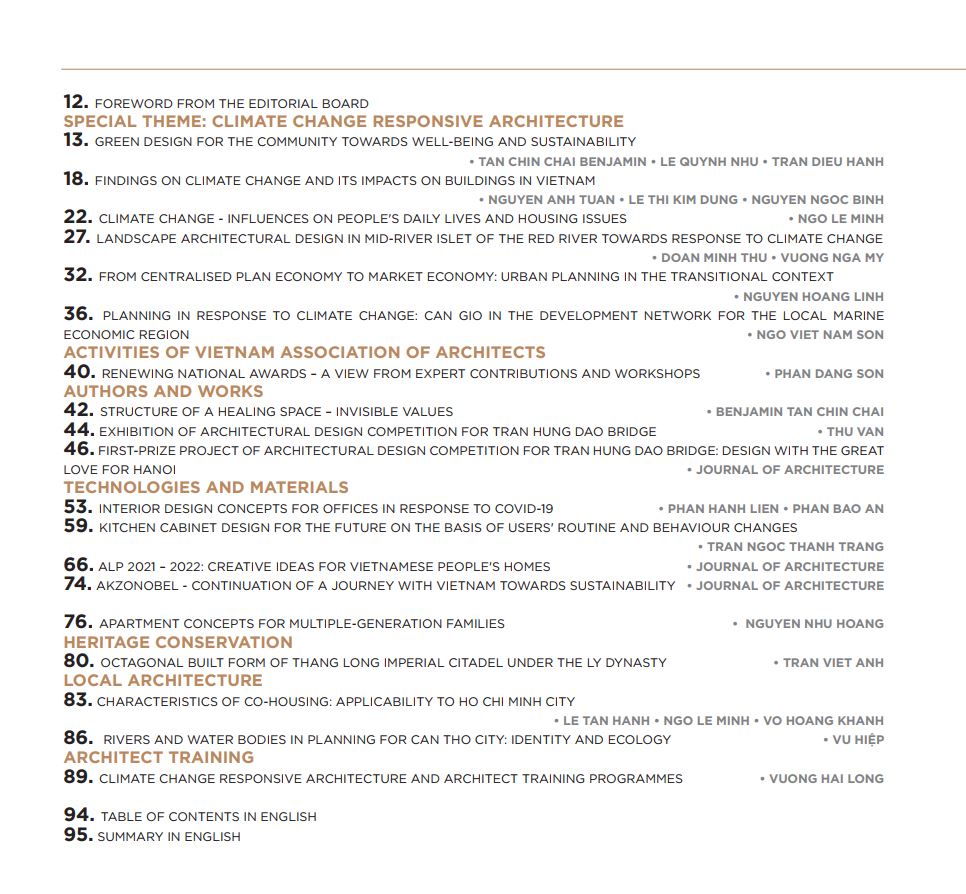
Just like many other countries, Vietnam as a country located on the Pacific coast, is hugely affected by climate change and sea level rise. Along with the rapid urbanisation, these impacts have left so many negative impacts on all socio-economic sectors and people’s daily lives, causing great losses of life, property and environment as well as natural ecosystems. In the meantime, it has posed great challenges to Planning, Architecture, Construction, etc.
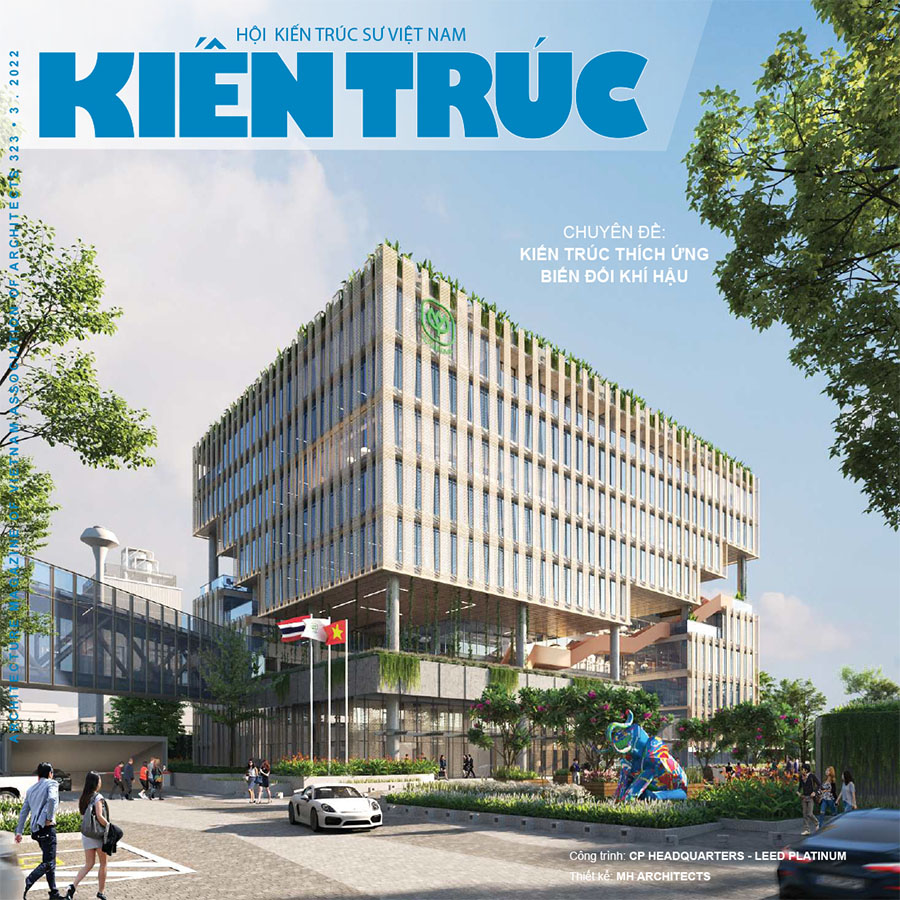
This issue – March 2022 – will introduce the topic “Architecture that adapts to climate change” to the readers with the content focusing on the research and practice of professionals in the design of various types of buildings that should meet numerous requirements, such as function, modern style and identity, responsiveness to climate change, etc. Along with the special theme, the Journal of Architecture will connect readers with professionals and relevant areas, finding solutions to help reduce environmental pollution, rationally and economically saving land resources, increasing the level of greening, using more area for walking, cutting down greenhouse gas emissions, avoiding floods, saving energy, making use of natural resources and renewable energy, etc.
This issue also affirms a message that has been oriented for the development of Vietnamese architecture: “In accordance with natural conditions, local culture and application of achievements of the digital era”. These are also mission strategies in design, in line with the mainstream of Green Architecture, Eco-Architecture, Energy-saving and Sustainable Architecture, etc. with support of new materials and modern technologies.
Specific studies and solutions proposed by experts for specific cities and province, such as Ho Chi Minh City, Can Tho, Can Gio and so on, were introduced in this issue with perspectives from the past experience and promotion of values of the traditional culture and architecture with the goal of considering and revitalising the so-called “green standard”. It can be a return to tradition from a modern and contemporary perspective, towards the harmonisation of opposite categories: “Traditional” and “Modern”, “Preservation” and “Development”, “Identity” and “Innovation”.
In March 2022 issue, the Journal of Architecture would like to introduce the results of the architectural design competition for Tran Hung Dao Bridge, which were displayed for public comments in the recent weeks. With the participation of architects, the results of the competition and the opinions of the community will be important to Hanoi People’s Committee to choose the most appropriate design concept. Our expectation is that Hanoi will have one more bridge – a symbol connecting space and time, in line with the development trend on both sides of the Red River in a new era.
Page: 13
GREEN DESIGN FOR THE COMMUNITY TOWARDS WELL-BEING AND SUSTAINABILITY
• TAN CHIN CHAI BENJAMIN • LE QUYNH NHU • TRAN DIEU HANH
In the midst of many problems of a modern society, when our emotions cannot keep up with the rapid development of technology, people gradually lose connections and become isolated individuals. With the four strategies presented on the basis of respecting the primal relationship between man and nature as a core principle, an energy revolution is expected to come; urban spaces should be reorganised for a food revolution; natural potentials can also be considered for ocean management solutions; and finally a wild environment needs to be brought back straight to the heart of the city. It is possible to realise that it is us, the people, who can take action to make more positive changes towards a more sustainable and flexible future, despite many upheavals that may occur. We are looking forward to new developments in architecture and urban areas in the coming years known as the post-Covid era.
Page: 18
FINDINGS ON CLIMATE CHANGE AND ITS IMPACTS ON BUILDINGS IN VIETNAM
• NGUYEN ANH TUAN • LE THI KIM DUNG
• NGUYEN NGOC BINH
Climate change responsive building is a challenge for today’s architects to deal with. In Vietnam, we still have too few studies on climate change in relation to architectural designs to be used as the basis for teaching, orientation as well as practical application. The problem is that regarding climate change as a matter of survival or not is still inconsistent, depending on the perception of each individual, especially national leaders associated with nationalism – those who put the national and personal interest above all. The issue of making buildings responsive or adaptive to climate change in the long-term development is becoming a more difficult task. Emissions from buildings must be reduced to move towards a zero-
carbon society. That goal requires many solutions to be implemented step by step and gradually moving towards synchronisation, in which architects and designers are also pioneers. In such a context, it is necessary for the construction sector, and for architects in particular, to go ahead against climate change and they should to show their own progress, at least in cognitive thinking, not just a “fashionable” term
that everyone talks about wherever they go.
Page: 22
CLIMATE CHANGE – INFLUENCES ON PEOPLE’S DAILY LIVES AND HOUSING ISSUES
• NGO LE MINH
Under the impact of climate change, Ho Chi Minh City and its surrounding areas are experiencing many negative changes, in which, flooding has occurred more frequently in recent years in suburban districts. Flooding caused by high tide directly affects some residential areas, especially in the south of the city. In fact, the current housing types and concepts show many inadequacies. In case of a high tide, it causes so much damage to houses, affecting daily lives and small business activities of households. Therefore, the solutions of housing architecture to adapt to flooding due to climate change proposed in this article are considered a reference to housing development that can adapt to climate change. Finally, the author would like to emphasise that, in order to realise these ideas and solutions, we need to expand our thinking, enhance our awareness and responsibility of the government and the community as well.
Page: 27
LANDSCAPE ARCHITECTURAL DESIGN IN MID-RIVER ISLET OF THE RED RIVER TOWARDS RESPONSE TO CLIMATE CHANGE • DOAN MINH THU • VUONG NGA MY
The alluvial mid-river islet of the Red River is an area of natural and wild beauty with a large open space. This space has not yet been exploited, fortunately. In addition to the cultivation of a few households, there are a few informal daily spontaneous services. However, with easier access than before, this place has started to be a favourite place for people and tourists because it is close to nature, with trees and water surface, quite far away from the bustling city life. Regarding urban management, this is also an
area that should be investigated in the future, with the goal of becoming a cultural park serving the community and developing tourism.
Page: 36
PLANNING IN RESPONSE TO CLIMATE CHANGE: CAN GIO IN THE DEVELOPMENT NETWORK FOR THE LOCAL MARINE ECONOMIC REGION
• NGO VIET NAM SON
Through studying the role that Can Gio plays in the orientation of marine economic development of Ho Chi Minh City, this article analyses the key issues of a marine urban area, with strategic orientations for conservation and development proposed for Can Gio in particular and for Ho Chi Minh City in general, highlighting the role of planning in management and development of the city towards a more sustainable future, coupled with good preparation for risks, such as climate change and sea level rise.
Page: 40
RENEWING NATIONAL AWARDS – A VIEW FROM EXPERT CONTRIBUTIONS AND WORKSHOPS
• PHAN DANG SON
The National Architecture Awards were established by the Government in 1993, assigned to Vietnam Association of Architects as a chairing organisation in collaboration with the Ministry of Construction, the Ministry of Culture, Sports and Tourism to take place every two years. Held for the first time in 1994, the National Architecture Awards have been organised 13 times so far. 2022 will be the 14th. Over the past 28 years with 14 award seasons, the National Architecture Awards have been identified as the only official National Award Programme, having the longest history and greatest prestige in architecture in Vietnam.
In addition to the achievements recognised by the whole society, there are also shortcomings that have gradually been seen over the years. The Association has been in consultation with experts from different disciplines, both architects and non-architects, and held a discussion to look back at a 28-year history of the National Architecture Awards on 12th of April 2022 at the headquarters of Vietnam Association of Architects. Vietnam Association of Architects hopes and tries to make the National Architecture Awards more and more prestigious and fulfil the criteria, making an essential contribution to the development of Vietnamese architecture as oriented and approved by the Government, with the goals Rich Vernacularity – Modern Integration – Sustainable Future.
Page: 42
STRUCTURE OF A HEALING SPACE – INVISIBLE VALUES • BENJAMIN TAN CHIN CHAI
The article analyses and explores the intangible values of the relationships between humans and architecture with the potential to heal the spirit. At the same time, it looks for and aims to study spatial structures that can facilitate psychological well-being. The term “relationship” should be emphasised, as it suggests that an individual may exist through the power of invisible internal factors. Without a link to energy sources, a city would not be itself. If there is no connection with human life, architecture will no longer be architecture.
Page: 59
KITCHEN CABINET DESIGN FOR THE FUTURE • TRAN NGOC THANH TRANG
Technology continues to develop. Many smart devices are emerging to help facilitate and automate cooking. However, the humans in the kitchen are irreplaceable, and the paper will focus more on exploration, creativity and entertainment experiences. Smart kitchen cabinets in the future do not only mean freeing people from manual labour in the kitchen, but will also need to be able to better understand people, in terms of psychophysiology, behaviour, habits, so that people should become the centre of attention and care. Health care is also the crucial point of culinary creativity.
Page: 80
OCTAGONAL BUILT FORM OF THANG LONG IMPERIAL CITADEL UNDER THE LY DYNASTY
• TRAN VIET ANH
Archaeological excavations at the site of Thang Long Imperial Citadel from 2002 until now have revealed architectural vestiges of successive periods; from Dai La period, to the Ly, Tran, Le and Nguyen dynasties.
Particularly, the Ly dynasty established a very unique, diverse and standard building complex. Especially the traces of the foundation of an octagonal building were discovered at the holes C4 – C5 in the south of zone C.
Xem thêm: https://www.tapchikientruc.com.vn/tap-chi-kien-truc/tap-chi-kien-truc-so-03-2022.html
© Tạp chí Kiến trúc